
Why should we hire you?
"Why should we hire you?" sounds like an invitation to boast. It is actually a test of whether you understood the job. The best answers name what the role needs, then show one piece of evidence for each, briefly.
What the interviewer is checking
- Behavioral
- Do you know what this role is for? An answer that would fit any job tells the interviewer you have not thought about this one.
- Communication
- Can you make a case in under a minute, with evidence, without sounding either arrogant or apologetic?
- Problem-Solving
- For technical and analytical roles, whether the evidence you pick shows how you work through a problem, not just that you finished something.
These are three of the five dimensions every interview is scored on. See the full rubric.
A weak answer and a stronger one
Weak answer
"Because I am hardworking, dedicated and a fast learner. I am very passionate about this field and I will give my hundred percent to the company. I am also a team player and I have good communication skills. I really want this job and I will not let you down."
Why it falls short
- Every claim is an adjective; none is evidence. Every other candidate says the same words.
- Nothing about this role or this company. The answer would fit any job.
- "I really want this job" is about you, not about what the team gets.
Stronger answer
"From the description, this role needs three things: solid SQL, someone who can turn a messy question from the business into a clear analysis, and someone who can explain the result to people who are not analysts. On SQL, as the data volunteer for our college placement cell I built a dashboard on its records, and I wrote every query behind it. On turning messy questions into analysis, during my internship the operations team asked why deliveries were late, and I broke that down into three questions I could actually check in the data. And on explaining results, I presented that analysis to the operations manager, who changed one routing rule because of it. I would bring the same approach here."
Why it works
- Names what the role needs first, which proves you read the job.
- One piece of evidence per need, each with what you did.
- Confident without superlatives; the evidence does the persuading.
- Swap in your own needs and evidence; never claim results you did not get.
How to build your answer in ten minutes
Read the job description and pull out the two or three things the role clearly needs most: a skill, a kind of problem and a way of working. For each one, find the single best piece of evidence you have from projects, internships, coursework or past jobs. Write one sentence per item. That is your answer.
If you cannot find evidence for something the role needs, do not invent it. Leave it out, or name it honestly as the thing you are working on. Interviewers trust a candidate who knows their gaps.
What makes the case unconvincing
A weak version usually does one of these:
- A list of adjectives: hardworking, passionate, team player.
- Comparing yourself to other candidates you have never met.
- Pleading or over-thanking instead of making a case.
- Talking about what the job will do for you rather than what you will do for the team.
Follow-up questions to expect
A good interviewer pushes on your answer. These are examples of the kind of follow-up to prepare for; our AI interviewer writes its own from what you actually said.
- "Which of those three are you least confident in?"
- "What was the routing rule, and how did you know it helped?"
- "Why this company rather than a larger one?"
- "What would you need from us in your first month?"
How to adjust it for your level
- Intern
- Make the case on how you learn: one example where you picked something up quickly and used it, plus the one skill from the posting you already have evidence for.
- New grad
- Use projects and internships as evidence, matched one to one against what the posting asks for. Two strong matches beat five weak ones.
- Experienced
- Lead with the result most like the problem this team has, then the skill that makes you ready on day one. Keep it to two or three points; your resume carries the rest.
- India campus placement
- The common version is "why should we hire you over other candidates with similar marks and projects?". Do not attack other candidates. Name what you did on your project that went beyond the requirement, and one thing you did outside the syllabus that this company would value.
Answer it out loud, then read the evidence
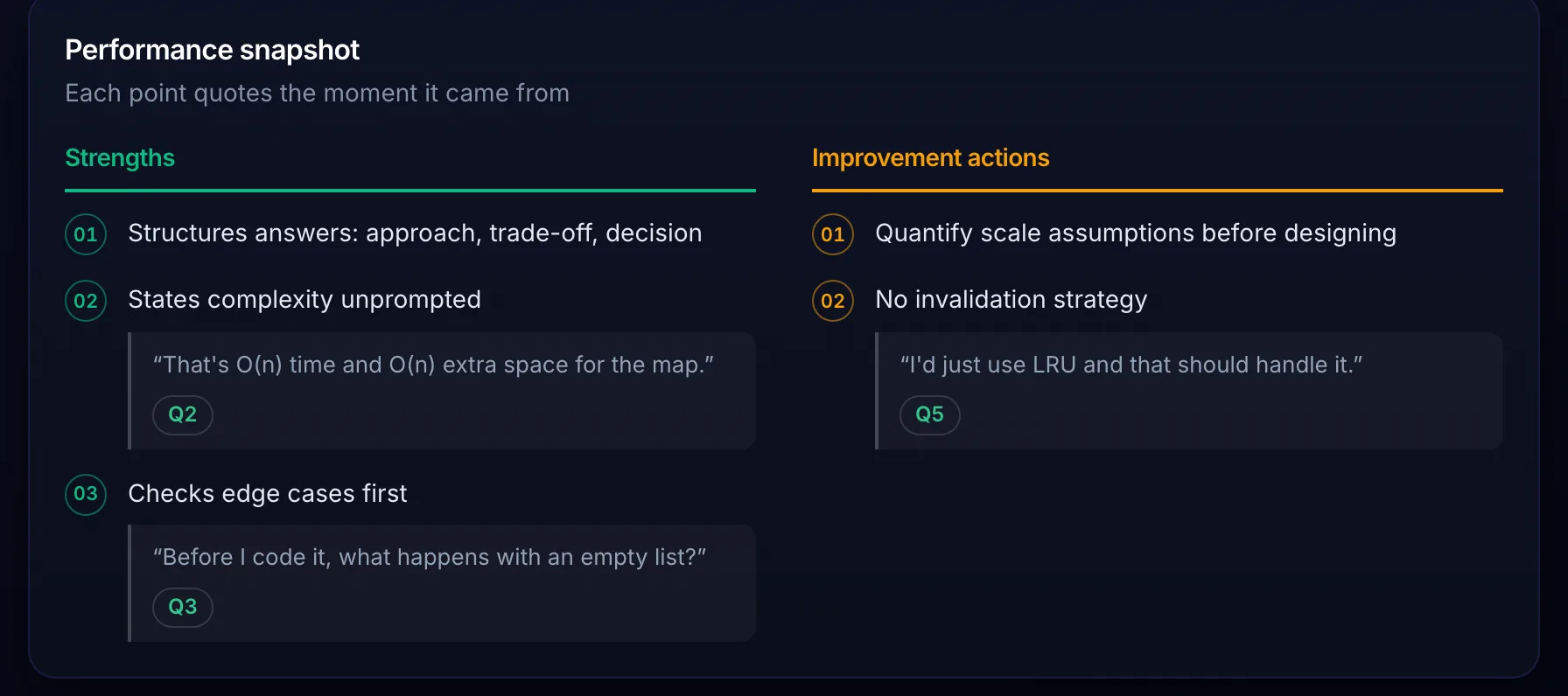
Reading a good answer is not the same as saying one. In a Practice interview the AI interviewer asks out loud, follows up on what you said, and the report quotes the sentences behind each strength and gap.
Frequently asked questions
How do I answer "why should we hire you" without sounding arrogant?
Let evidence carry the weight. State what the role needs, then what you did that shows it, in plain words. Facts about your work do not sound arrogant; superlatives about yourself do.
How do I answer "why should we hire you" as a fresher with no experience?
Use projects, internships, coursework and anything you built yourself as evidence. Match each to something the posting asks for, and say what you personally did.
Should I mention salary or my need for the job?
No. This question is about what the team gets. Keep salary for the conversation about compensation and keep personal circumstances out of the case.
How long should the answer be?
Under a minute out loud: two or three needs, one piece of evidence each. If the interviewer wants more on one point, they will ask, and that follow-up is where you go deeper.
What if I do not meet every requirement?
Few candidates do. Build the answer on the requirements you can prove, and if asked about a gap, say how you are closing it with something concrete you are already doing.
Can I practice this question with an AI interviewer?
Yes. In a free Practice interview the AI interviewer follows up on the evidence you give, the way a hiring manager would. The report quotes the sentences behind each strength and gap, and Practice never counts toward a verified score.
More common questions: Tell me about yourself, What are your strengths and weaknesses?, Why do you want to work here?, Where do you see yourself in 5 years?, Tell me about a time you failed, Tell me about a time you had a conflict with a coworker, Why are you leaving your current job?, What is your greatest achievement?, How do you handle pressure?. Or browse interview questions by role and interview prep.