
Tell me about yourself
"Tell me about yourself" is usually the first question, and it sets the frame for everything after it. It is not a request for your life story. It is an invitation to explain, in about a minute, why you are a sensible person to be sitting in this interview for this role.
What the interviewer is checking
- Communication
- Can you organize your own story and say it clearly in about a minute, without wandering? This is the first sample of how you will explain everything else.
- Behavioral
- Do you have a reason for being here? Interviewers listen for a thread that connects what you have done to the role, not a list of everything you have done.
- Technical
- For technical roles, which one or two pieces of work you choose to mention, and whether you can name what you actually did on them.
These are three of the five dimensions every interview is scored on. See the full rubric.
A weak answer and a stronger one
Weak answer
"Sure. I was born in Pune and grew up there, then I did my schooling at a local school. After that I joined engineering, computer science. I did a lot of things in college, I was in a few clubs, and I did some projects. I like coding and I also like playing cricket. Right now I am looking for a job where I can learn and grow."
Why it falls short
- Starts at birth and spends most of the minute on things that do not matter to the interviewer.
- "A lot of things" and "some projects" name nothing the interviewer can ask about.
- Ends on what you want ("learn and grow"), not on what you bring, so the interviewer has no next question.
Stronger answer
"I am a final-year computer science student, and most of what I have built is on the backend side. The project I am proudest of is a library-booking API for our college, which students in our department now use to book study rooms; I designed the database schema and wrote the booking logic, including handling two people booking the same slot. Last summer I interned at a logistics startup, where I wrote the scripts that cleaned their delivery data before it went into reports. Those two things are why I applied here: this role is backend work on data that real people depend on, and that is the work I have enjoyed most."
Why it works
- Present, past, future: who you are now, two pieces of evidence, why this role.
- Each piece of evidence names what you personally did, so the interviewer has a follow-up ready.
- Ends by connecting your story to the job, which hands the interviewer the next question.
- Replace the details with yours, and use only numbers that are true for you.
A structure that works: present, past, future
Start with where you are now in one sentence: your current role or year of study and the kind of work you do. Then give two pieces of evidence from the past, each with what you personally did. Finish with the future: why this role is the logical next step. That is the whole answer.
Aim for about a minute when you say it out loud. Shorter sounds rehearsed and thin; much longer and the interviewer stops listening and starts waiting for you to finish.
What makes the answer fall flat
Weak answers tend to fail in a few predictable ways:
- Reading your resume aloud in order. The interviewer has it in front of them.
- Personal history nobody asked for: hometown, schooling, hobbies, unless they connect to the role.
- Adjectives instead of evidence: "hardworking", "passionate", "a quick learner".
- No ending. Trailing off with "so, yeah" leaves the interviewer to rescue you.
Follow-up questions to expect
A good interviewer pushes on your answer. These are examples of the kind of follow-up to prepare for; our AI interviewer writes its own from what you actually said.
- "You mentioned two people booking the same slot. How did you handle that?"
- "What would you change about that project if you started it again?"
- "Why backend rather than frontend?"
- "What did you find hardest at the internship?"
How to adjust it for your level
- Intern
- You are not expected to have job experience. Use coursework, a project and anything you built on your own, and say what you want to learn in this internship specifically, not "to gain experience".
- New grad
- Lead with your degree and the one or two projects or internships that match the role. One sentence on why this company or team, said plainly, beats a paragraph of praise.
- Experienced
- Start with your current role and scope, pick the two results most relevant to this job, and explain why you are moving now. Keep the career history to what explains the move.
- India campus placement
- In HR and managerial rounds at campus drives, name your branch and college in the first sentence, then your final-year project and internships, then why this company. Keep marks and ranks to one line unless they ask; spend the time on what you did.
Answer it out loud, then read the evidence
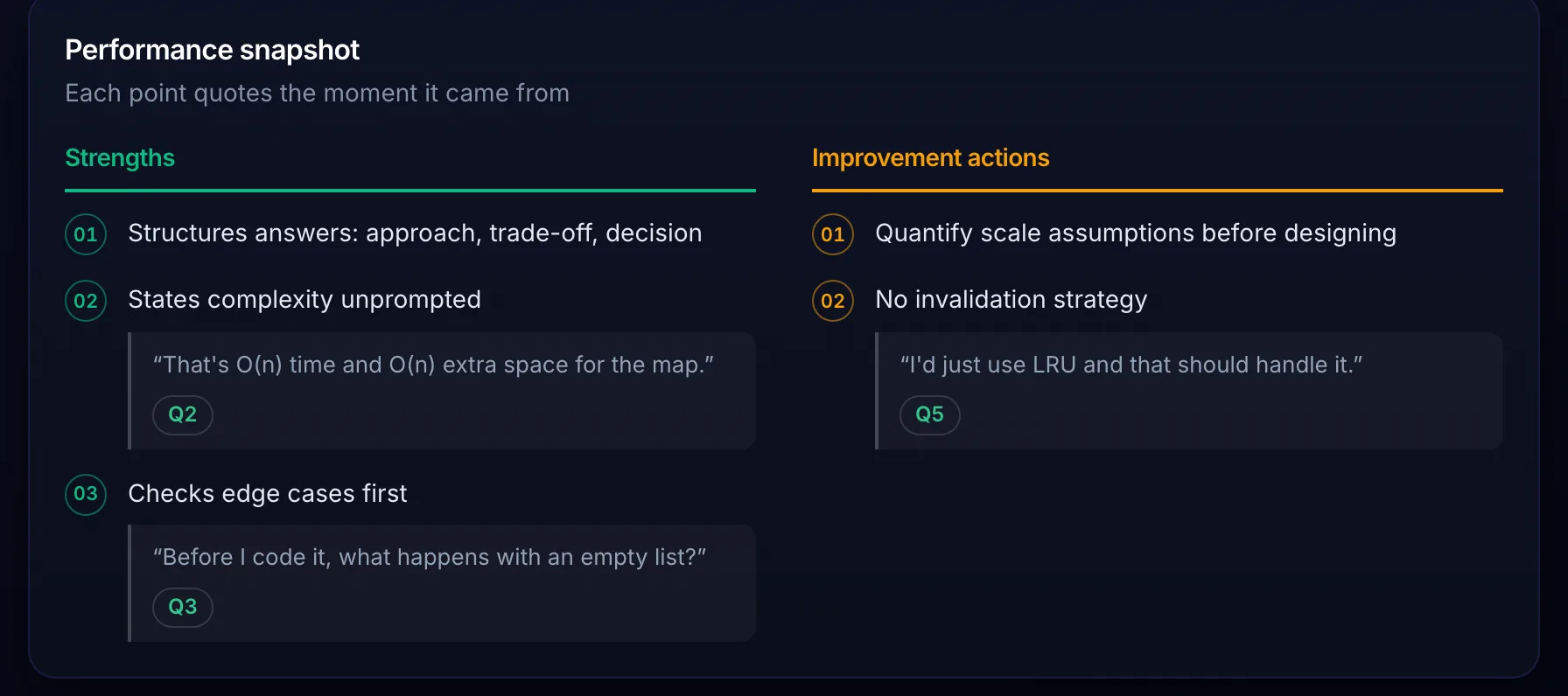
Reading a good answer is not the same as saying one. In a Practice interview the AI interviewer asks out loud, follows up on what you said, and the report quotes the sentences behind each strength and gap.
Frequently asked questions
How long should my answer to "tell me about yourself" be?
About a minute out loud. That is long enough for who you are now, two pieces of evidence and why this role, and short enough that the interviewer is still listening at the end.
Should I mention personal details or hobbies?
Only if they connect to the role or say something useful about how you work. Your hometown and schooling usually do not; a hobby where you built or led something sometimes does.
Is it okay to memorize my answer?
Memorize the structure and the two pieces of evidence, not the sentences. A memorized script sounds recited and falls apart when the interviewer interrupts with a follow-up.
How do I answer "tell me about yourself" as a fresher?
Use your degree, your strongest project and any internship as the evidence, say what you personally did on each, and finish with why this role fits what you have enjoyed most.
What if the interviewer asks "walk me through your resume" instead?
Use the same structure, a little longer: the interviewer wants the thread through your resume, not every line of it. Pick the items that explain why you are applying for this job.
Can I practice "tell me about yourself" with an AI interviewer?
Yes. A free Practice interview opens much like a real one and follows up on what you say, so you can hear whether your minute holds together. The report quotes the sentences behind each strength and gap, and Practice never counts toward a verified score.
More common questions: Why should we hire you?, What are your strengths and weaknesses?, Why do you want to work here?, Where do you see yourself in 5 years?, Tell me about a time you failed, Tell me about a time you had a conflict with a coworker, Why are you leaving your current job?, What is your greatest achievement?, How do you handle pressure?. Or browse interview questions by role and interview prep.