
What is your greatest achievement?
"What is your greatest achievement?" invites you to brag, and most candidates either do it badly or apologize. The interviewer wants one specific story where you did something hard, can say exactly what you contributed, and can show what changed because of it.
What the interviewer is checking
- Behavioral
- What you value and how you define success: an achievement that cost you real effort says more than a prize you were handed.
- Communication
- Can you separate what you did from what the team did, and say so without inflating or hiding your part?
- Technical
- For technical roles, whether you can explain the work well enough that the interviewer could ask a second question and get a real answer.
These are three of the five dimensions every interview is scored on. See the full rubric.
A weak answer and a stronger one
Weak answer
"My greatest achievement is that I got good marks in my degree and was a topper in my class. I am also proud that I did many projects and was a team leader. I worked very hard to achieve these things and I am proud of them."
Why it falls short
- A list of results with no story, so there is nothing for the interviewer to ask about.
- "Many projects" and "team leader" name no project, no problem and no outcome.
- It describes effort ("worked very hard") instead of what you did and what it changed.
Stronger answer
"In my final year our department's placement tracker was a shared spreadsheet that kept breaking, because several people edited it at once and rows were overwritten. I volunteered to fix it. I interviewed the three coordinators about what they needed, then built a small web app on a database, with a status for each student and a log of who changed what. I ran it with the coordinators for one placement season, fixed the problems they reported, and by the end they had stopped using the spreadsheet. What I am proudest of is that it kept working after I graduated, because I wrote a one-page guide and trained a junior to take it over."
Why it works
- One specific story with a problem, your actions in order and a result.
- "I" is used for what you did and the coordinators and junior appear as part of the story.
- The best detail is that it lasted after you left: impact beyond yourself.
- Choose an achievement that is true for you and that you can answer three follow-ups about.
Structure the story with STAR
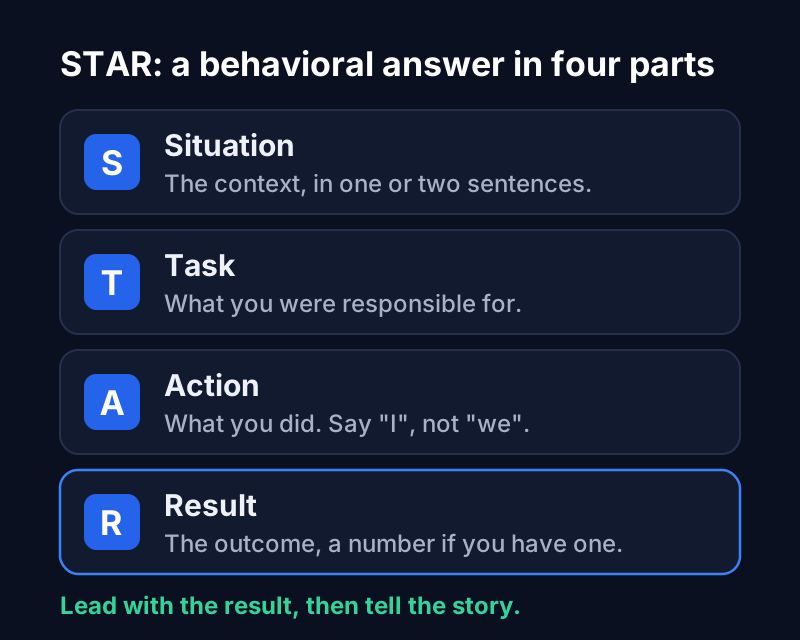
Situation: the problem and why it mattered, in a sentence or two. Task: what you took responsibility for. Action: the two or three things you personally did, in order. Result: what changed, in a form the interviewer can picture. If you have a true number, use it; if you do not, a plain description of the change is stronger than an invented figure.
Aim for about two minutes and keep the setup short. The action is the part that is scored.
How to pick the achievement
Choose the one that best matches what the job will ask of you, not the one that sounds most impressive. A modest result you drove from start to finish beats a famous award you cannot explain.
- Something you owned or drove, not something that happened near you.
- A result someone other than you noticed.
- Recent enough that the details are fresh.
- Relevant to the role, even if the setting is academic or personal.
Follow-up questions to expect
A good interviewer pushes on your answer. These are examples of the kind of follow-up to prepare for; our AI interviewer writes its own from what you actually said.
- "What was the hardest technical decision in that project?"
- "What would you do differently if you built it again?"
- "How did you know the coordinators actually wanted this?"
- "Tell me about an achievement that was not technical."
How to adjust it for your level
- Intern
- A project, competition, club or event you drove is a good source. The scale does not matter; the specificity of what you did does.
- New grad
- Pick the project or internship where you owned the outcome, and say what you built or changed. Leave marks out unless they ask; stories carry more than scores.
- Experienced
- Choose a result with business consequence that you led or drove, and say how the team and you split the work. Senior candidates are expected to name the trade-offs they made along the way.
- India campus placement
- Panels often ask this near the end. A final-year project, a hackathon or a student-body responsibility works if you can explain your own part in two minutes. Skip long lists of certificates.
Answer it out loud, then read the evidence
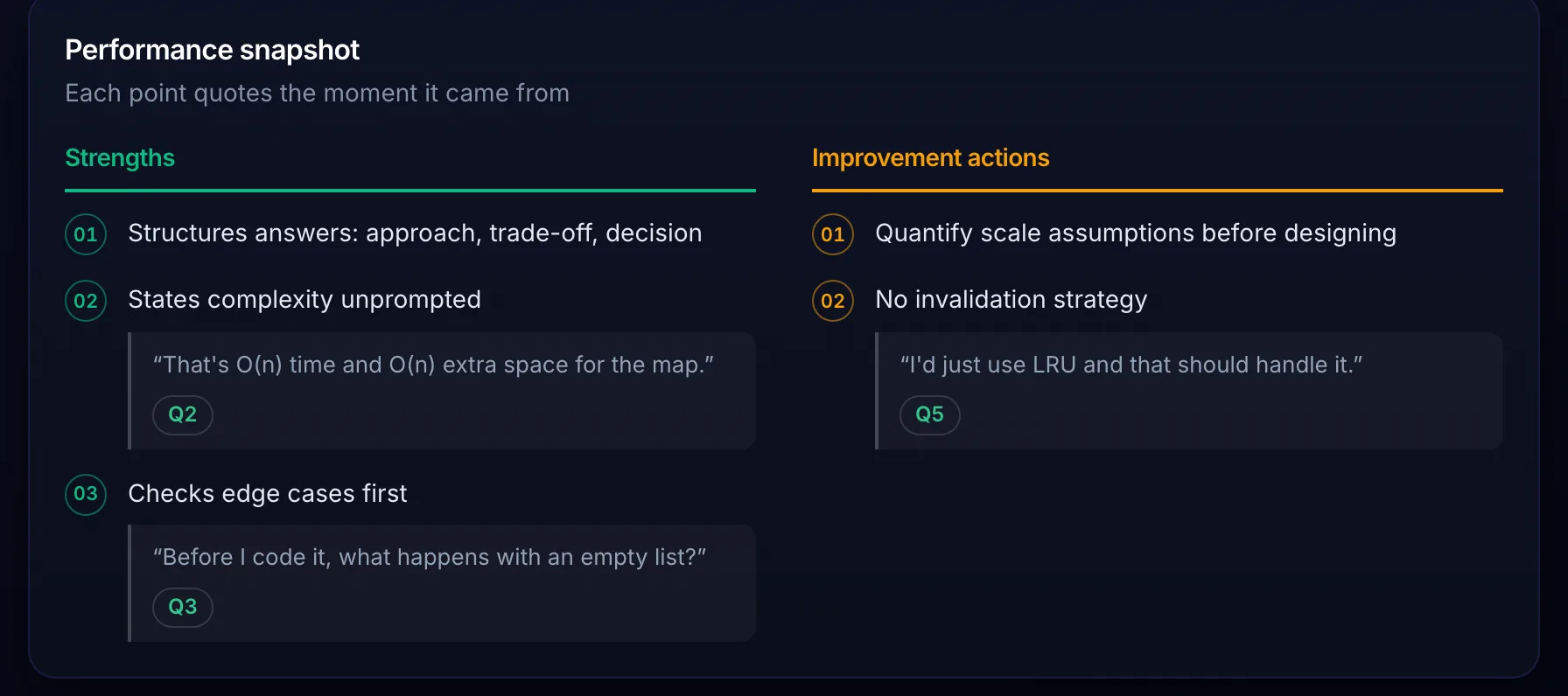
Reading a good answer is not the same as saying one. In a Practice interview the AI interviewer asks out loud, follows up on what you said, and the report quotes the sentences behind each strength and gap.
Frequently asked questions
What is a good example of a greatest achievement?
One where you owned a hard problem, can say exactly what you did and can show what changed. It can be a project, an internship result, a competition or a responsibility; the setting matters less than the specifics.
Should my achievement be work-related?
It helps if it is, but it does not have to be. A study or project story is fine if it shows skills the job needs, such as ownership, learning fast or working with others.
How do I answer as a fresher?
Use a project, internship, event or responsibility that you drove. Describe the problem, your own actions and the result, and avoid a list of marks and certificates.
How do I talk about a team achievement without taking all the credit?
Say "we" for the outcome and "I" for what you personally did. Naming your own part clearly while crediting others sounds confident and honest.
How long should the answer be?
About two minutes: a short setup, your actions, the result and one line on what lasted or what you learned.
Can I practice this question with an AI interviewer?
Yes. A free Practice interview asks it out loud and follows up on your specific part, which is where a vague achievement shows. The report quotes the sentences behind each strength and gap, and Practice never counts toward a verified score.
More common questions: Tell me about yourself, Why should we hire you?, What are your strengths and weaknesses?, Why do you want to work here?, Where do you see yourself in 5 years?, Tell me about a time you failed, Tell me about a time you had a conflict with a coworker, Why are you leaving your current job?, How do you handle pressure?. Or browse interview questions by role and interview prep.