
What are your strengths and weaknesses?
The strengths and weaknesses question is really a self-awareness test. Interviewers are not hunting for a fatal flaw. They want to see whether you know how you work, can back up a strength with evidence, and are honestly doing something about a real weakness.
What the interviewer is checking
- Behavioral
- Self-awareness: is the weakness real, and are you actually working on it? A disguised strength ("I work too hard") reads as either unaware or evasive.
- Communication
- Can you give a strength with a concrete example, and talk about a weakness without either hiding it or over-confessing?
- Technical
- For technical roles, whether your strength is something the job uses, shown through a specific piece of work.
These are three of the five dimensions every interview is scored on. See the full rubric.
A weak answer and a stronger one
Weak answer
"My strength is that I am a perfectionist and very hardworking. My weakness is also that I am a perfectionist, so sometimes I work too hard and do not take breaks. I am working on it."
Why it falls short
- The weakness is a strength in disguise, so the interviewer learns nothing about how you actually work.
- No example for the strength, so there is nothing to believe.
- "I am working on it" with no detail sounds like a line, not a habit.
Stronger answer
"A strength: I break big problems into small, checkable pieces. In my final-year project, our recommendation feature was not working and the team kept rewriting it; I suggested we test each step separately, and we found the bug was in how we cleaned the input, not the model. A weakness: I have been slow to ask for help. In my internship I spent most of two days stuck on a deployment problem that my mentor solved in twenty minutes once I asked. Since then I set myself a rule: if I am stuck for an hour with no progress, I write down what I have tried and ask. It has made me faster, and the written notes usually get me a better answer."
Why it works
- The strength comes with a short story: situation, what you did, result.
- The weakness is real, specific and relevant to work, but not disqualifying for the role.
- The improvement is a concrete habit, with evidence that it is working.
- Use your own real strength and weakness; an invented one collapses under a follow-up.
How to choose a weakness to talk about
Pick something real that affects your work, that you have noticed yourself, and that you have already started to fix. Avoid weaknesses that are core requirements of the job: an analyst who says "I am not careful with numbers" has answered the question and lost the interview.
Good areas to look at: asking for help, saying no, presenting to groups, estimating how long work takes, giving direct feedback, or a specific skill gap you are closing with a course or project.
Give the strength a story with STAR
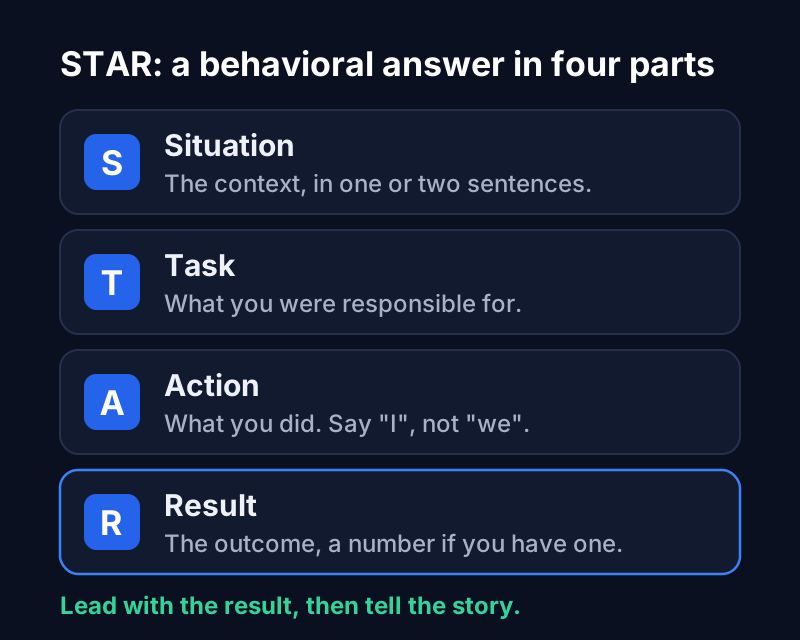
A strength without an example is an opinion. Back it with a short STAR story: the situation in a sentence, what you were responsible for, what you did, and the result. Thirty seconds is enough. If the interviewer wants more detail, they will ask.
Follow-up questions to expect
A good interviewer pushes on your answer. These are examples of the kind of follow-up to prepare for; our AI interviewer writes its own from what you actually said.
- "Tell me about a time that strength did not work."
- "How do you decide when an hour of being stuck is enough?"
- "What feedback have you received that surprised you?"
- "What is a weakness your last manager or professor would mention?"
How to adjust it for your level
- Intern
- Draw both from coursework, projects and group work. A weakness like nervousness presenting is fine if you can say what you are doing about it, such as volunteering to present in class.
- New grad
- Use your strongest project or internship for the strength. For the weakness, pick something from team or project work and the concrete habit you have built since.
- Experienced
- Choose a strength that matches this role and a weakness from your current job, with how your manager or team has seen it improve. Senior candidates are expected to describe weaknesses more precisely, not less.
- India campus placement
- Some HR rounds ask for "three strengths with an example of each". Prepare three short examples rather than three adjectives, and keep each to two or three sentences.
Answer it out loud, then read the evidence
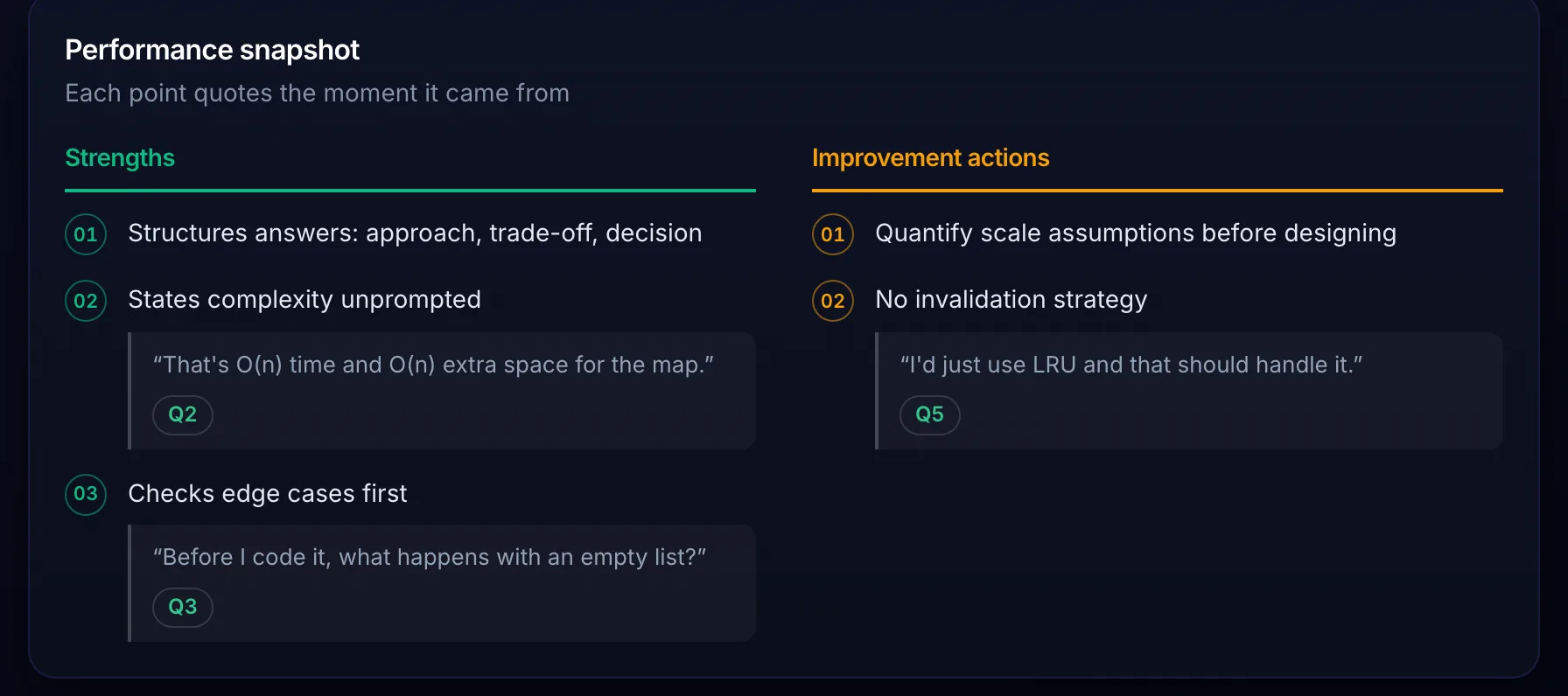
Reading a good answer is not the same as saying one. In a Practice interview the AI interviewer asks out loud, follows up on what you said, and the report quotes the sentences behind each strength and gap.
Frequently asked questions
What is a good weakness to say in an interview?
A real one that is not central to the job, that you noticed yourself and are already working on with a concrete habit. Common examples are asking for help late, struggling to say no, or nervousness presenting.
Should I say "I am a perfectionist" as my weakness?
No. It reads as a strength in disguise and tells the interviewer nothing. Pick something genuine and show what you are doing about it.
How many strengths should I mention?
One or two, each with an example, unless the interviewer asks for more. If they ask for three, keep each to a sentence or two of evidence.
How do I answer as a fresher?
Take the strength from your best project or internship with what you did, and the weakness from study or group work with the habit you have built to fix it.
What if I cannot think of a weakness?
Ask people who have worked with you, or look at feedback from a project or internship. Saying you have none usually reads as low self-awareness.
Can I practice this with an AI interviewer?
Yes. A free Practice interview follows up on the examples you give, which is where a vague strength or a disguised weakness shows. The report quotes the sentences behind each strength and gap, and Practice never counts toward a verified score.
More common questions: Tell me about yourself, Why should we hire you?, Why do you want to work here?, Where do you see yourself in 5 years?, Tell me about a time you failed, Tell me about a time you had a conflict with a coworker, Why are you leaving your current job?, What is your greatest achievement?, How do you handle pressure?. Or browse interview questions by role and interview prep.