
Why are you leaving your current job?
"Why are you leaving your current job?" is a judgment test. The interviewer is not hunting for a villain at your old employer. They want a reason that is true, that points toward the role in front of them, and that you can state without bitterness.
What the interviewer is checking
- Behavioral
- Professionalism and motivation: are you moving toward something specific, or only away from something? A reason that would follow you to the next job is a warning sign.
- Communication
- Can you give a short, honest reason without blaming a manager or a team, and without over-explaining?
- Problem-Solving
- Did you try to fix the problem where you were first? Candidates who raised it, asked for a different scope or tried a new project show they do not simply leave when work gets hard.
These are three of the five dimensions every interview is scored on. See the full rubric.
A weak answer and a stronger one
Weak answer
"My manager does not appreciate my work and the team is very disorganized. I have been doing the same tasks for two years with no growth, and the pay is also below market. I just cannot continue there anymore, so I want to find a better company."
Why it falls short
- It is all complaint about the old employer, which tells the interviewer how you will talk about this one.
- Every reason is about what you want to escape; nothing explains why this job.
- No sign you tried to change the situation before leaving.
Stronger answer
"For three years I have worked on the internal reporting tools for our sales team, and I have learned a lot about turning messy requests into reliable dashboards. About six months ago I asked to move onto customer-facing analytics, but the team has no work like that planned, so I have been building a small usage-tracking project on my own to keep learning. This role is the customer-facing analytics work I have been trying to get closer to, and your team ships it as the main product. I leave on good terms, and I want to spend the next few years going deeper on exactly this."
Why it works
- The reason is about direction and growth, stated with no blame.
- It shows an attempt to solve the problem inside the current job first.
- It ends on this role, so the answer is a reason to join, not only a reason to leave.
- Use your real reason; if money or a manager is part of it, leave it out rather than invent a nicer story.
How to build your answer
Pick the one true reason that is also fair to say aloud: scope you have outgrown, work you want to do that your team does not offer, a company change such as a restructure or a closed project, or a move that your life requires. Say it in a sentence, add one line on what you did about it where you are, and then turn to this role.
Keep it to about thirty seconds. The longer you stay on the old job, the more the interviewer hears about it instead of about you.
Reasons that count against you
These tell the interviewer what working with you is like when something goes wrong:
- Blaming a manager, team or company by name.
- Leading with salary as the only reason.
- A story with no step you took before deciding to leave.
- A different reason from the one your references will give.
Follow-up questions to expect
A good interviewer pushes on your answer. These are examples of the kind of follow-up to prepare for; our AI interviewer writes its own from what you actually said.
- "Did you raise this with your manager before deciding to leave?"
- "What would have kept you there?"
- "What are you looking for that you did not have in your last role?"
- "How would your current manager describe your reasons for leaving?"
How to adjust it for your level
- Intern
- You usually will not be leaving a job. If asked why you are leaving a previous internship or part-time role, say what you learned there and what you want to learn next.
- New grad
- If you left a first job quickly, say what you learned about the kind of work you want, plainly and without blame, and why this role fits that better.
- Experienced
- State the real reason once, keep your former employer out of it, and connect it to something specific in this role. If you were laid off, say so in a sentence and move to what you are looking for.
- India campus placement
- Freshers sometimes get a version of this: "why leave your current offer or training?". Keep it about the role and what the new company offers you to learn, and never run down the other company.
Answer it out loud, then read the evidence
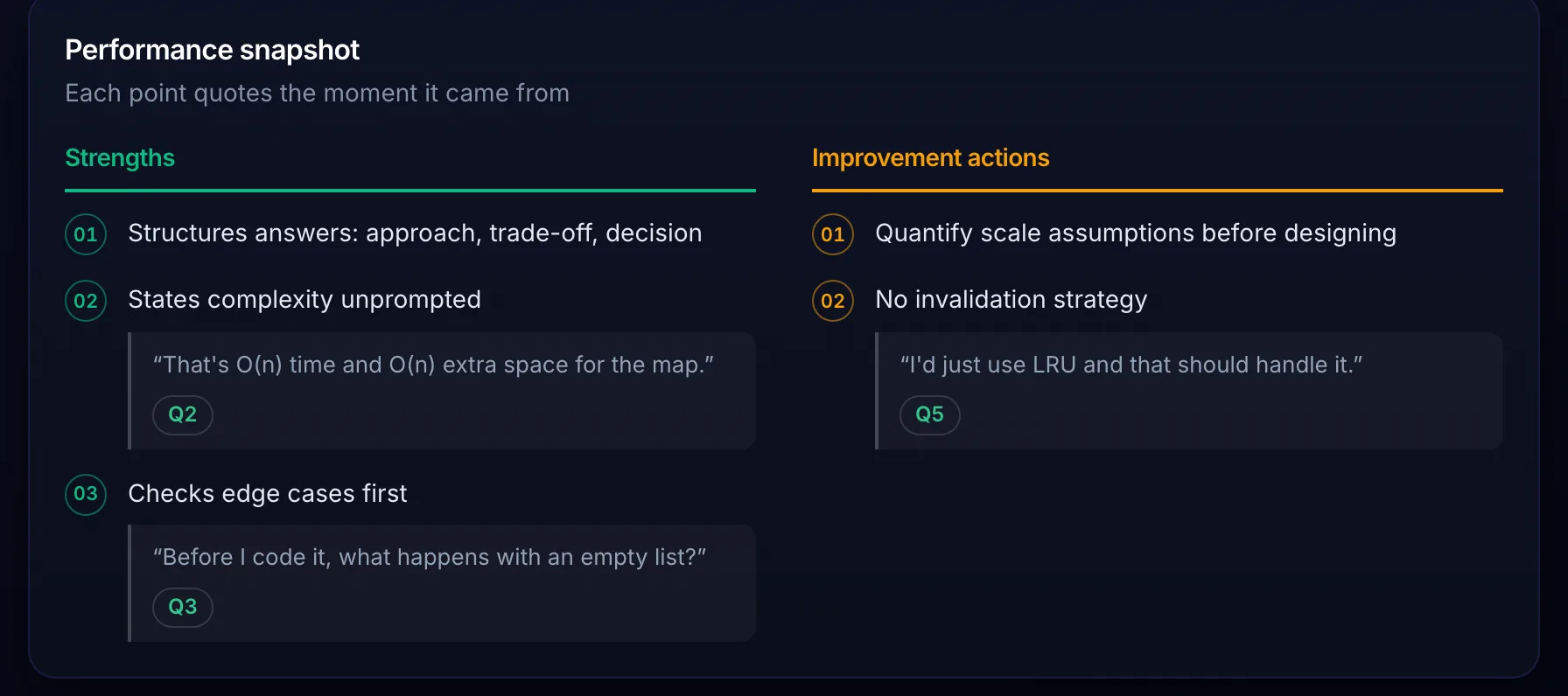
Reading a good answer is not the same as saying one. In a Practice interview the AI interviewer asks out loud, follows up on what you said, and the report quotes the sentences behind each strength and gap.
Frequently asked questions
What is a good reason for leaving a job in an interview?
A true one that points forward: work you have outgrown, a skill you want to build that your team does not offer, or a company change. Pair it with one thing you tried where you are, and tie it to this role.
Should I be honest if I am leaving because of my manager?
Be honest without blaming. You can say you want a different scope or style of working without describing the manager. Interviewers read criticism of a former boss as a preview of how you will talk about them.
How do I answer if I was laid off or fired?
Say it plainly in one sentence, without spin, then move on to what you learned or what you are looking for. A short, calm answer lands better than a long defense.
Is it okay to say the pay is a reason?
It is a fair part of a move but a weak lead. Lead with growth or the kind of work, and keep compensation for the conversation about the offer.
How long should the answer be?
About thirty seconds: the reason, one step you took, and why this role. Longer invites the interviewer to dig into the old job.
Can I practice this question with an AI interviewer?
Yes. A free Practice interview asks it out loud and follows up on what you did before leaving, which is where a blame-heavy answer shows. The report quotes the sentences behind each strength and gap, and Practice never counts toward a verified score.
More common questions: Tell me about yourself, Why should we hire you?, What are your strengths and weaknesses?, Why do you want to work here?, Where do you see yourself in 5 years?, Tell me about a time you failed, Tell me about a time you had a conflict with a coworker, What is your greatest achievement?, How do you handle pressure?. Or browse interview questions by role and interview prep.