AI mock interview
An AI mock interview here is a spoken conversation, not a quiz. You pick the role you are applying for, an AI interviewer asks the questions a real screen would ask, and it follows up on your answers. At the end you get a report you can act on.
Free plan, no card required.
How it works
Pick your role
Choose the job you are preparing for, from software engineering to nursing, teaching or product. The questions, follow-ups and rubric are set for that role and level.
Talk it through
The AI interviewer asks a question out loud, listens to your answer and follows up on what you actually said, the way a human screener does. You answer by speaking, not typing.
Read the report
You get a report with an overall score, the strengths and gaps it found, and the exact sentence from your interview behind each one, so you know what to fix before the next round.
What makes it an interview, not a question list
Many interview prep tools hand you a list of questions and a timer. That trains you to recite. A real interviewer does something different: they listen, then push on the weakest part of your answer. "You said the migration was risky. What would you have rolled back first?" That second question is where a rehearsed answer gets tested, and it is the one a question list never asks.
Our AI interviewer runs the conversation live, by voice. It asks one question at a time, waits for you to finish, and decides the next question from what you said. If your answer is vague it asks for an example. If your example is strong it goes deeper. You practice the part of interviewing that is actually hard: thinking on your feet while someone is listening.
Practice interviews and Lifelike interviews
There are two kinds of AI mock interview, and the difference matters.
- Practice interviews are for rehearsal. A fast animated interviewer, a report with feedback at the end, and nothing counts: a practice session never touches your verified score and is not part of your Profile Card. The free plan is Practice-only and needs no card.
- Lifelike interviews are the real thing. A photo-real interviewer with real-time lip sync, graded against a published rubric. Each one updates the Profile Card score recruiters can check. Lifelike grading comes with the paid plans.
How the AI interviewer grades you
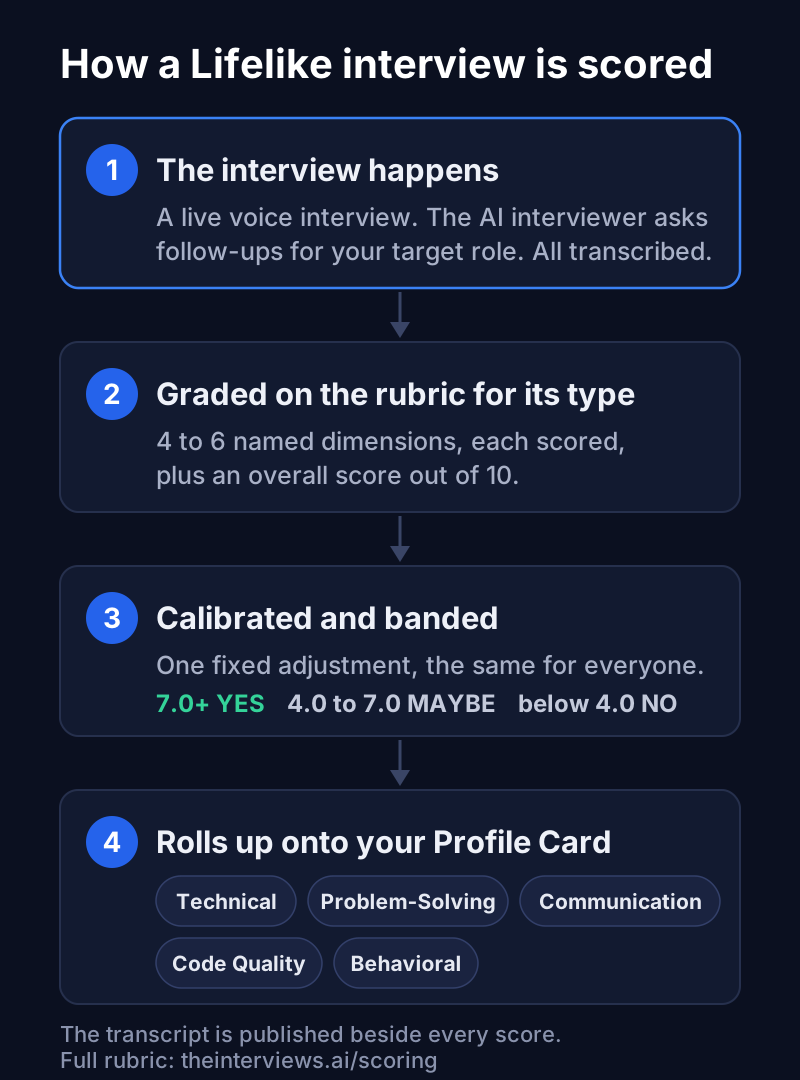
Every interview type has its own rubric with four to six named dimensions. A behavioral interview is graded on collaboration, communication, self-awareness and real examples; a coding round on correctness, code quality, efficiency and approach. Each dimension gets a score, then the interview gets an overall score out of 100 and a YES, MAYBE or NO recommendation.
Those dimensions then roll up into five canonical ones: Technical, Problem-Solving, Communication, Code Quality and Behavioral. That is what lets a behavioral interview and a coding interview sit on one Profile Card. The full rubric is published, and so is our own evaluation of the scorer, including where it is weaker than a human rater.
What you get back
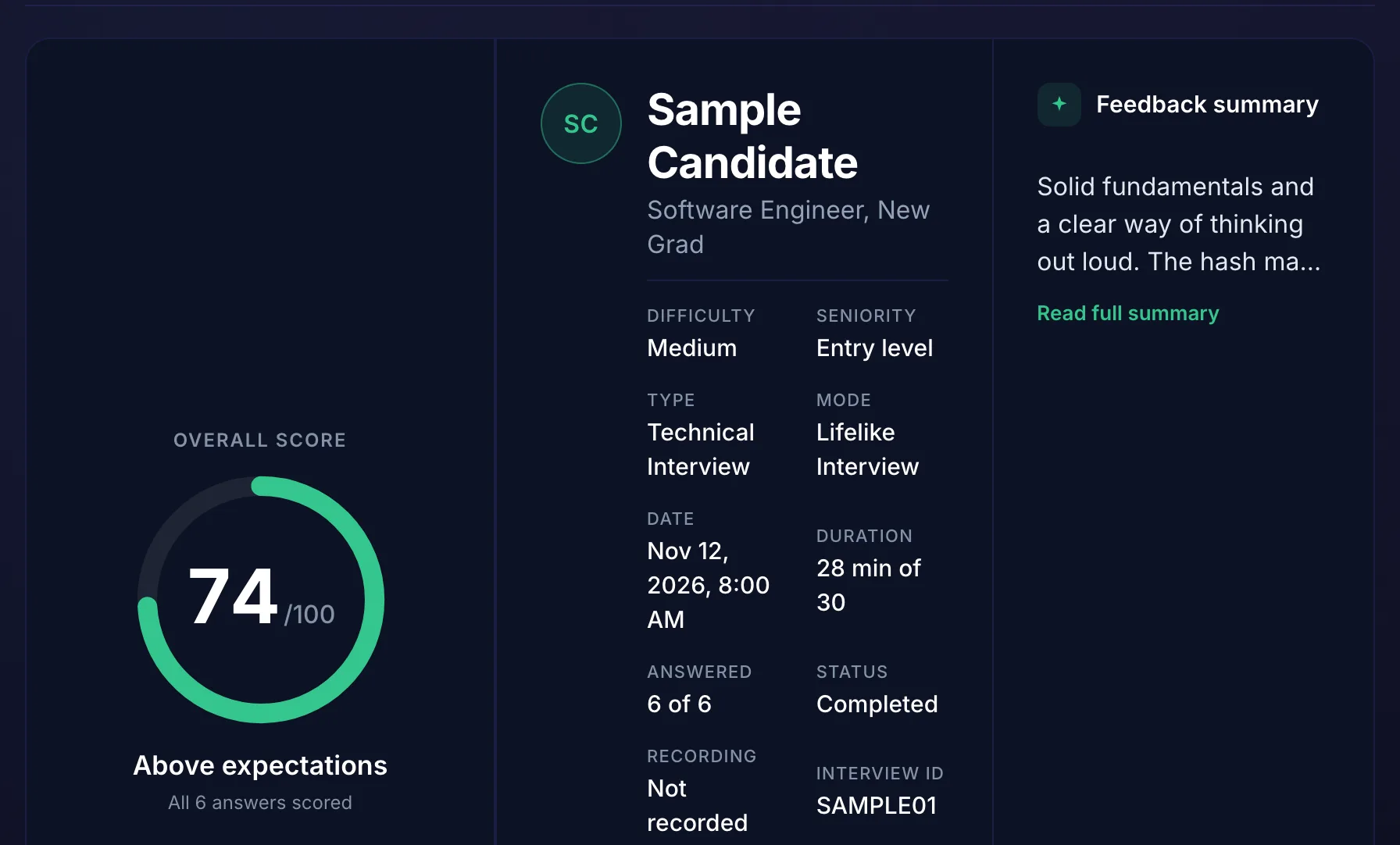
The report is built so you can act on it in the ten minutes before your next attempt. The overall score and its band sit at the top. Under it, every strength and every gap quotes the exact sentence from your interview it came from. "Communication: weak" tells you nothing; seeing the sentence where you lost the thread tells you what to change.
The full transcript stays with the report. If a score and the transcript ever disagree, the transcript is the record, and you can read it yourself.
Who it is for
Students and new graduates preparing for their first screens, people changing careers who need to explain a new story out loud, and experienced candidates who have not interviewed in years. It is also useful the night before a real interview: one honest run tells you which answer is still weak.
Interviews run in a modern browser with microphone and camera access. There is nothing to install and nothing to schedule.
Frequently asked questions
Is the AI mock interview free?
Yes, to start. The free plan runs Practice interviews with a feedback report and keeps a private Profile Card, with no card required. Paid plans add graded Lifelike interviews, which put a verified score on your card.
Does the AI interviewer really ask follow-up questions?
Yes. It decides each next question from your previous answer, so a vague answer gets a request for an example and a strong one gets a harder follow-up. It is a live voice conversation, not a fixed list read in order.
Do I type or speak my answers?
You speak. The interview is a voice conversation, because the skill being tested is explaining your thinking out loud. You need a browser with microphone and camera access.
Will recruiters see my practice interviews?
No. Practice interviews never count toward your verified score and are not part of your Profile Card. Only Lifelike interviews are graded onto it, and your card is private by default; sharing it or appearing to recruiters is something you opt into.
How is an AI mock interview scored?
Against a rubric chosen for the interview type: four to six dimensions, each scored, plus an overall score out of 100 and a YES, MAYBE or NO recommendation. Those dimensions map onto five canonical ones so different interview types compare on one card. The rubric is published on the scoring page.
Is an AI score reliable?
Partly, and we publish where it is not. Our own evaluation found the scorer separates behaviorally distinct candidates less well than a human rater does. That result is published with its method, and the transcript ships with every score so you can check the evidence yourself.
Is my interview data private?
Yes. Interview recordings are encrypted at rest in AWS storage, your Profile Card is private by default, we never sell data, and you can request full deletion at any time.