
Tell me about a time you failed
"Tell me about a time you failed" is a behavioral question, and the failure itself matters less than what you did next. Interviewers want a real failure that you owned, a clear account of what went wrong, and evidence that you changed how you work because of it.
What the interviewer is checking
- Behavioral
- Ownership: do you describe your own part in what went wrong, or does the story drift toward a teammate, a professor or bad luck?
- Problem-Solving
- Can you name the actual cause of the failure, not just the symptom, and the specific change you made so it does not happen again?
- Communication
- Can you tell an uncomfortable story briefly and in order, without over-explaining or getting defensive?
These are three of the five dimensions every interview is scored on. See the full rubric.
A weak answer and a stronger one
Weak answer
"Honestly, I have not really failed at anything major. In one group project our grade was lower than expected, but that was mostly because two team members did not do their part on time. I did my section well. I learned that you cannot always depend on other people."
Why it falls short
- "I have not really failed" reads as unaware or evasive.
- The failure is blamed on teammates, so there is no ownership to assess.
- The lesson is about other people, not about anything you now do differently.
Stronger answer
"In my third year I offered to build the registration site for our college tech fest. I was confident about the pages and assumed the payment step would take a day, so I left it for the final week. It took far longer, and we opened registrations two days late, after the posters had already gone out with the date. The cause was mine: I estimated the part I knew and guessed at the part I did not. I apologized to the organising team, we extended the early-bird deadline to make up for it, and since then I start every project with the piece I understand least and give it a deadline of its own. On my internship project that habit flagged an unfamiliar API in the first week, which gave my mentor time to help before it became a delay."
Why it works
- Situation, task, action and result in order, in under two minutes.
- The failure is real and had a visible cost, but it is not disqualifying for the role.
- The cause is named precisely and owned, with no blame on anyone else.
- The lesson is a habit, with a later example showing it working. Use a failure that is true for you.
Structure the story with STAR
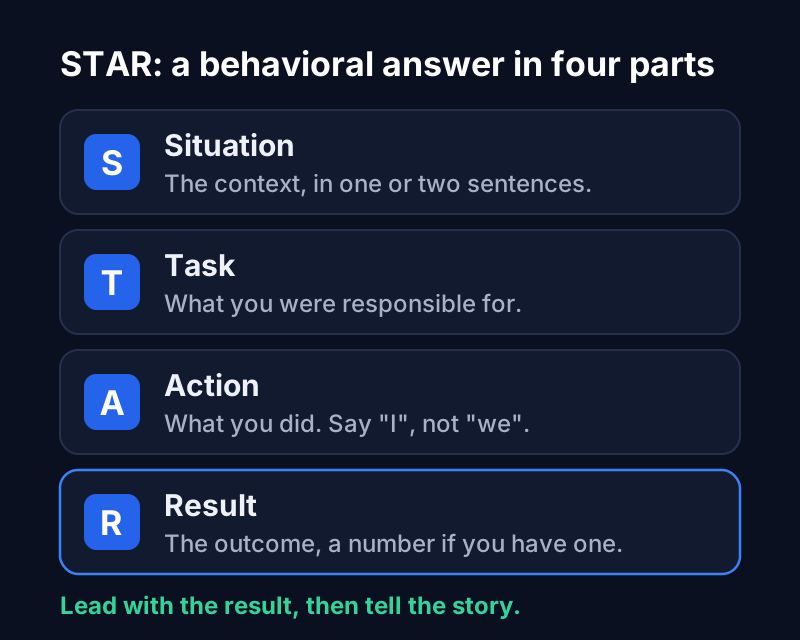
Use STAR: the situation in a sentence or two, what you were responsible for, what you did, and the result, including the bad part. Then add the step that matters most: what you learned and what you now do differently, with a later example if you have one.
Keep the failure itself to about a third of the answer. The rest belongs to the cause, the recovery and the change, because that is the part the interviewer is actually scoring.
How to choose the failure
Pick something real with a visible consequence: a missed deadline, a project that did not work, a decision that turned out wrong. Avoid a failure that goes to the core of the job you are applying for, and avoid one so small that it is not really a failure.
- A real cost that someone other than you noticed.
- A cause that was at least partly yours.
- A change in how you work that you can point to since.
Follow-up questions to expect
A good interviewer pushes on your answer. These are examples of the kind of follow-up to prepare for; our AI interviewer writes its own from what you actually said.
- "What would you do differently if you ran that project again?"
- "How did the organising team react, and how did you handle it?"
- "How do you estimate work now when you have not done it before?"
- "Tell me about a time that habit did not help."
How to adjust it for your level
- Intern
- Coursework, a club or event, a competition or a personal project are all fine sources. An intern is not expected to have professional failures; honesty and a lesson are what count.
- New grad
- Use a project or internship story with a real deadline or user. A failure inside a team is good material as long as you describe your own part, not the team's.
- Experienced
- Pick a work failure with a business consequence and your part in it. Senior candidates are expected to describe the cause more precisely and to show how they changed a process, not only their own habit.
- India campus placement
- In HR rounds this can come as "tell me about a setback", and a backlog or a low semester is a fair, honest answer. If you use one, keep it short and spend the time on what you changed and how your results since show it.
Answer it out loud, then read the evidence
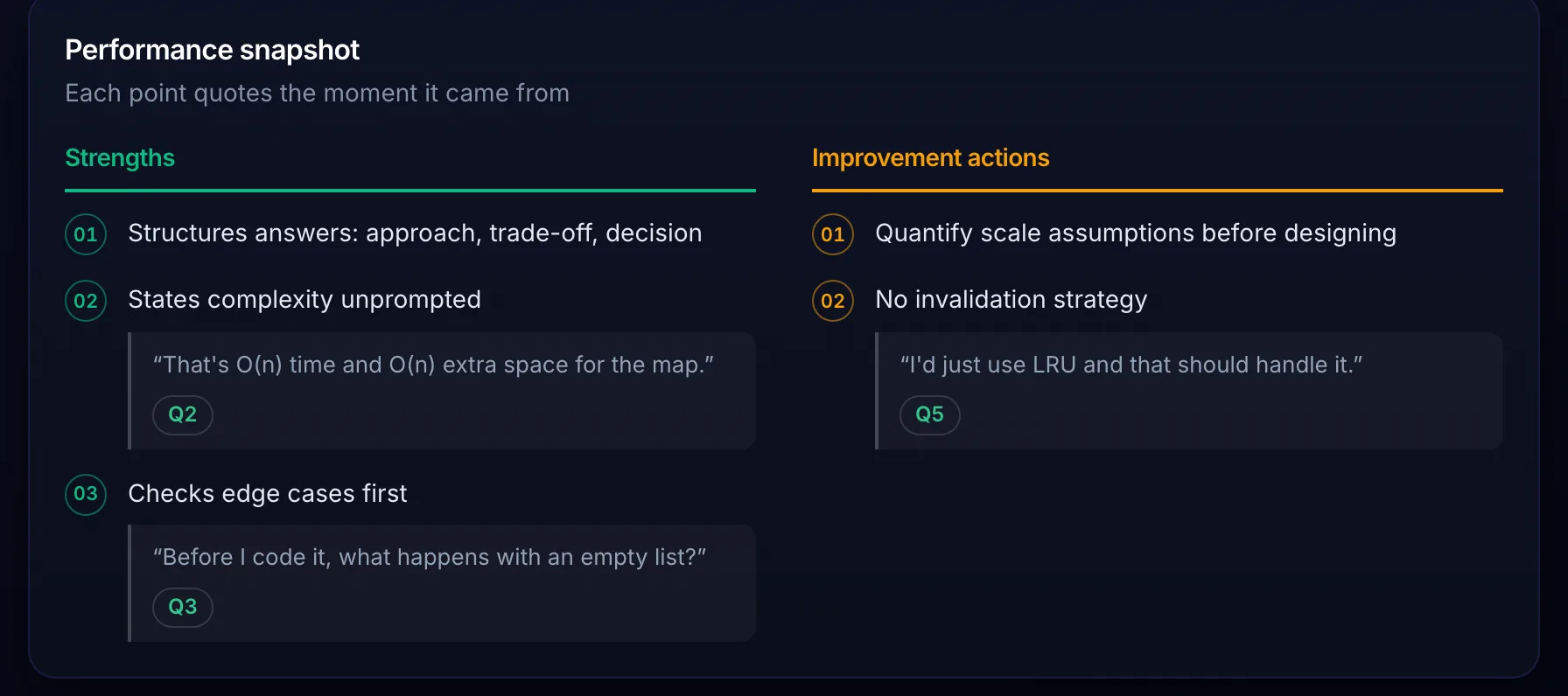
Reading a good answer is not the same as saying one. In a Practice interview the AI interviewer asks out loud, follows up on what you said, and the report quotes the sentences behind each strength and gap.
Frequently asked questions
What is a good failure to talk about in an interview?
A real one with a visible cost, where at least part of the cause was yours and you can show what you now do differently. Avoid failures that go to the core skills of the job.
Is it okay to say I have never failed?
No. Everyone has failed at something, and saying otherwise tells the interviewer you are either unaware or avoiding the question.
How do I answer as a fresher with no work experience?
Use a project, a competition, a club event or coursework. What matters is ownership of the cause and the change you made, not where the failure happened.
How long should the answer be?
Under two minutes. Spend about a third on what happened and the rest on the cause, how you recovered and what you do differently now.
Should I talk about a personal failure or a work failure?
Work, study or project failures are safer and more relevant. A personal story can work if it shows how you work, but keep private matters out of it.
Can I practice this question with an AI interviewer?
Yes. A free Practice interview asks behavioral questions out loud and follows up on your story, so you can check that the cause and the lesson come through. The report quotes the sentences behind each strength and gap, and Practice never counts toward a verified score.
More common questions: Tell me about yourself, Why should we hire you?, What are your strengths and weaknesses?, Why do you want to work here?, Where do you see yourself in 5 years?, Tell me about a time you had a conflict with a coworker, Why are you leaving your current job?, What is your greatest achievement?, How do you handle pressure?. Or browse interview questions by role and interview prep.