
How do you handle pressure?
"How do you handle pressure?" is a trap for generic answers. "I stay calm and work harder" tells the interviewer nothing. A good answer names what pressure looks like for you, describes one real moment, and shows the specific things you do when time or stakes go up.
What the interviewer is checking
- Behavioral
- Self-awareness and composure: do you know what pressure does to you, and have you built habits that work against it?
- Problem-Solving
- When time is short, do you prioritize and decide what to cut, or do you try to do everything and hope?
- Communication
- Do you tell the people who depend on you early when something is at risk, or do they find out when it is late?
These are three of the five dimensions every interview is scored on. See the full rubric.
A weak answer and a stronger one
Weak answer
"I actually work better under pressure. I stay calm, I do not get stressed and I just work harder and longer until the work is done. Deadlines motivate me, and I have never missed one."
Why it falls short
- "I do not get stressed" and "never missed one" are claims no interviewer believes.
- "Work harder and longer" is not a method, and it hints at burnout, not skill.
- No story, so there is nothing to test.
Stronger answer
"Two days before our final-year project demo, our database crashed and we lost the data we had loaded for the demo. There were four of us. I first asked everyone to stop and wrote down what had to work on the day: the login, the search and the results page. We dropped the reports feature, which was nice to have but not essential. I rebuilt the data from the backup script while two teammates fixed the search, and I told our guide that evening what we had cut and why. The demo ran on time with the three core features working. Since then I write the must-haves on a card on day one, so when something breaks I already know what to protect."
Why it works
- A concrete moment with stakes and a deadline.
- The method is visible: stop, list what must work, cut the rest, divide the work, tell people.
- It shows communication upward, not only effort.
- It ends with a habit. Replace the story with a real one and keep the same shape.
Structure the story with STAR
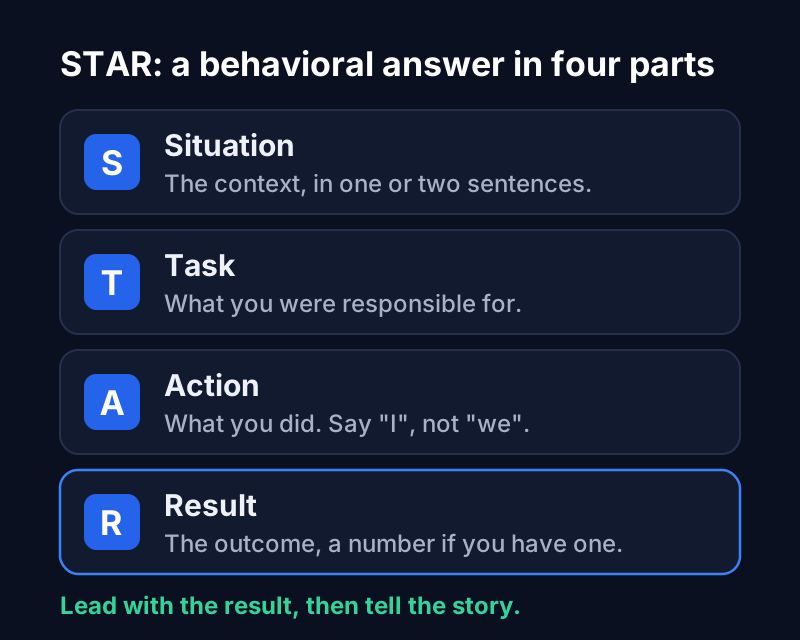
Situation: what was due and what went wrong, in a sentence or two. Task: what you were responsible for. Action: the two or three things you did, in order, with the reason for each. Result: what was delivered and what you do differently now.
Make the method the center of the story. Interviewers learn from what you do in the first ten minutes of a bad day, not from how you felt.
Honest answers beat tough-guy answers
Admitting that pressure affects you is not a weakness if you can say what you do about it. The candidates who sound least convincing claim to be unaffected.
- Name what pressure feels like for you, such as rushing or going quiet, and the habit that counters it.
- Show prioritizing: what you protected and what you gave up.
- Show telling people early, not late.
- Avoid answers that depend on working all night as the plan.
Follow-up questions to expect
A good interviewer pushes on your answer. These are examples of the kind of follow-up to prepare for; our AI interviewer writes its own from what you actually said.
- "How did you decide what to cut?"
- "What would you have done if the backup had also failed?"
- "Tell me about a time pressure made you make a bad call."
- "How do you tell your manager that a deadline is at risk?"
How to adjust it for your level
- Intern
- Exams, project deadlines, events and hackathons are fair sources. Show how you decided what to do first, not how many hours you worked.
- New grad
- Use a project deadline or an internship incident with real consequences. One clear method beats a dramatic story with no lesson.
- Experienced
- Pick a moment with business stakes and describe how you prioritized, communicated to stakeholders and protected the team. Senior candidates are expected to show how they reduced the pressure for others.
- India campus placement
- This often comes as "how do you handle deadlines and exams together?". Use a real example such as a final-year project week or a hackathon, and show your planning rather than your stamina.
Answer it out loud, then read the evidence
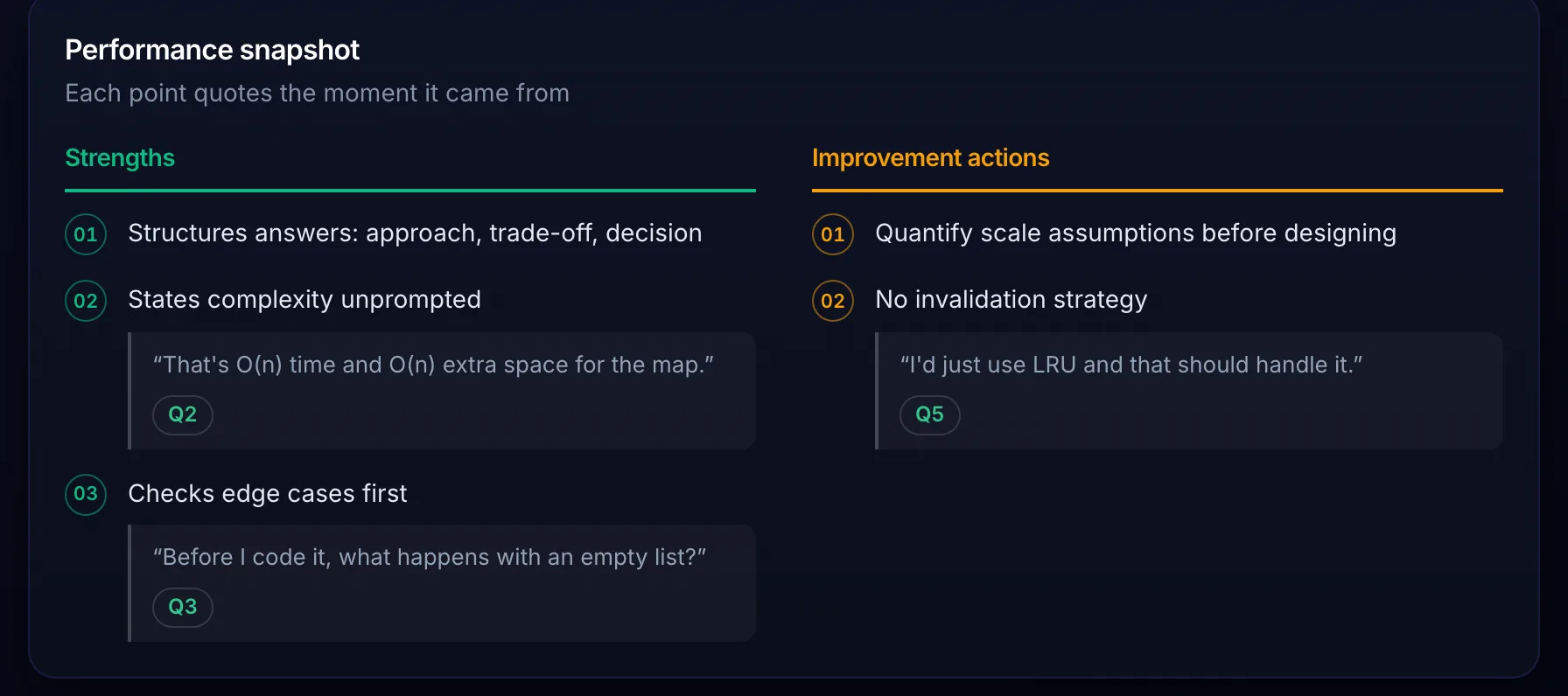
Reading a good answer is not the same as saying one. In a Practice interview the AI interviewer asks out loud, follows up on what you said, and the report quotes the sentences behind each strength and gap.
Frequently asked questions
What is a good answer to "how do you handle pressure"?
A short true story where you prioritized, communicated early and delivered what mattered, with one habit you built afterward. The method matters more than the drama.
Is it okay to say I work well under pressure?
Only with a story behind it. The bare claim is the most common answer and carries no information.
What if I get stressed easily?
Say so briefly, and describe the habit you use, such as listing must-haves or telling your lead early. Self-awareness with a method is a strong answer.
How do I answer as a fresher?
Use an exam week, a project deadline or an event. Show how you decided what to do first and what you dropped.
How long should the answer be?
About two minutes: a short setup, three actions, the result and the habit you kept.
Can I practice this question with an AI interviewer?
Yes. A free Practice interview asks it out loud and follows up on how you decided what to protect. The report quotes the sentences behind each strength and gap, and Practice never counts toward a verified score.
More common questions: Tell me about yourself, Why should we hire you?, What are your strengths and weaknesses?, Why do you want to work here?, Where do you see yourself in 5 years?, Tell me about a time you failed, Tell me about a time you had a conflict with a coworker, Why are you leaving your current job?, What is your greatest achievement?. Or browse interview questions by role and interview prep.