
Where do you see yourself in 5 years?
"Where do you see yourself in 5 years?" is not a request for a career prediction. The interviewer wants to know whether this job fits the direction you are heading, and whether you are likely to stay long enough to grow in it. A good answer describes the skills and responsibility you want to build, not a job title.
What the interviewer is checking
- Behavioral
- Fit and commitment: does this role sit on the path you describe, or is it a stop on the way to something unrelated?
- Communication
- Can you describe a direction clearly without either a vague "I want to grow" or a rigid plan that sounds rehearsed?
- Technical
- For technical roles, whether you can name the skills you want to deepen, which shows you understand what getting better at this work looks like.
These are three of the five dimensions every interview is scored on. See the full rubric.
A weak answer and a stronger one
Weak answer
"In five years I see myself as a manager in this company, leading a big team. Or maybe I will do an MBA and start my own business. I want to be in a senior position and earn well. I am very ambitious."
Why it falls short
- Jumps to a title with no path from this job to it.
- Mentions leaving, for an MBA or a startup, in the same breath.
- Ambition with no skill or responsibility named; the interviewer cannot picture what you would actually be doing.
Stronger answer
"In five years I want to be someone the team trusts with a whole system, not just tickets inside it. In the first couple of years that means getting very good at the fundamentals here: writing reliable backend code, learning how the product is used and handling production issues well. After that, I would like to own a part of the system end to end and help newer engineers the way the senior engineers on my internship team helped me. Whether that becomes a lead role or a senior engineering role, I would decide with my manager based on what I turn out to be good at. This role is a strong start on that path because it is backend work on a product people depend on."
Why it works
- Describes skills and responsibility, which this job can actually lead to.
- Shows a sensible order: learn the fundamentals, then take on more.
- Open about titles without being vague about direction.
- Ends by tying the plan back to this role.
Build the answer around skills, not titles
Titles mean different things at different companies, and the interviewer cannot promise you one. Skills and responsibility travel. Describe what you want to be good at and what you want to be trusted with, then explain how this role starts you on that path.
If you genuinely do not know what you want in five years, say what you want in the next two, and how you will decide after that. That is an honest answer, and it usually lands better than a plan that sounds rehearsed.
Answers that raise a flag
Each of these makes the interviewer doubt you will stay:
- Saying you plan to leave: further studies, a startup, another field.
- "In your job" or "running this company", which sounds like a joke or a challenge.
- "I have not thought about it", with nothing after it.
- A plan so detailed and rigid that it leaves no room for the job you are applying for.
Follow-up questions to expect
A good interviewer pushes on your answer. These are examples of the kind of follow-up to prepare for; our AI interviewer writes its own from what you actually said.
- "What would you need from us to get there?"
- "What will you do if that path is not available here?"
- "Do you see yourself more as a manager or a specialist?"
- "What have you done in the last year to move toward that?"
How to adjust it for your level
- Intern
- Keep it short: the field you want to work in after graduating and the skills this internship helps you build toward it. Saying you hope to return full time is fine if it is true.
- New grad
- Describe the first two years as learning the craft well, then the kind of ownership you want after that. Connect both to what this team works on.
- Experienced
- Name the next level of scope you want, technical depth or leading people, and why this role builds toward it better than staying where you are. Be honest if you are weighing management against a specialist path.
- India campus placement
- Some HR panels use this to check whether you will leave early for higher studies or a government exam, especially at companies with a service agreement. If further study is in your plan, do not hide it, but explain how this job fits the years before it and what you will learn here.
Answer it out loud, then read the evidence
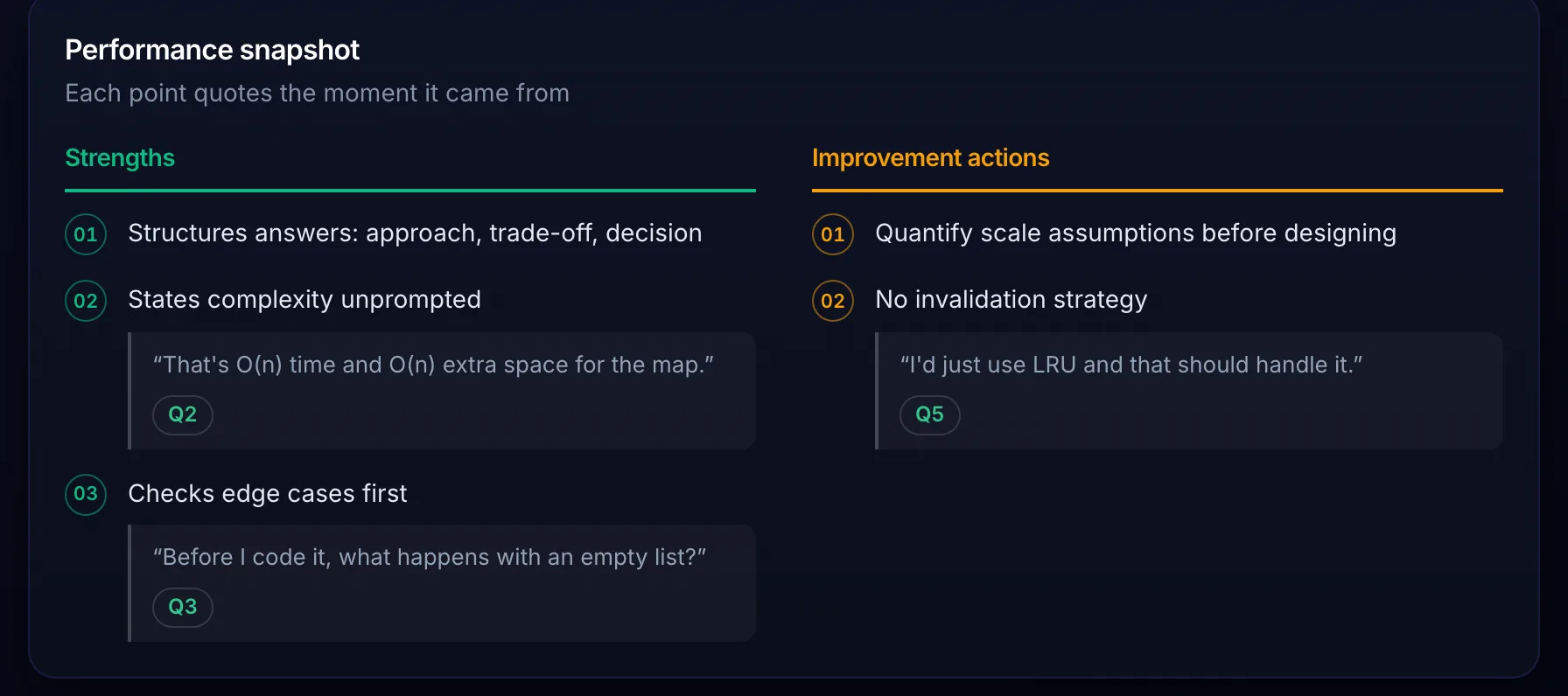
Reading a good answer is not the same as saying one. In a Practice interview the AI interviewer asks out loud, follows up on what you said, and the report quotes the sentences behind each strength and gap.
Frequently asked questions
What is the best answer to "where do you see yourself in 5 years"?
One that describes the skills and responsibility you want to build, shows a sensible path to them, and explains how this role is a step on that path. Avoid naming a title the company cannot promise.
Should I say I want to be a manager?
Only if you mean it, and describe it as leading people or projects rather than a title. If you are not sure yet, say you want more ownership and will decide between management and a specialist path as you learn what you are good at.
What if I plan to do higher studies or an MBA?
Do not lie about it, but do not lead with it. Explain what you want to learn in this job first, and how the years here fit into your plan.
How do I answer as a fresher?
Talk about learning the fundamentals of the role well in the first couple of years, then the kind of work you want to own after that. Tie it to the team you are interviewing for.
Is it okay to say I do not know?
Not on its own. It is fine to say you are not sure about five years, as long as you then say what you want from the next two and how you will decide.
Can I practice this question with an AI interviewer?
Yes. A free Practice interview follows up on your plan the way an interviewer would, for example by asking what you have done toward it. The report quotes the sentences behind each strength and gap, and Practice never counts toward a verified score.
More common questions: Tell me about yourself, Why should we hire you?, What are your strengths and weaknesses?, Why do you want to work here?, Tell me about a time you failed, Tell me about a time you had a conflict with a coworker, Why are you leaving your current job?, What is your greatest achievement?, How do you handle pressure?. Or browse interview questions by role and interview prep.