
Tell me about a time you had a conflict with a coworker
The conflict question is about how you work with people when you disagree. Interviewers are not looking for a story where you were right. They want to see that you can disagree on the substance, keep the relationship working, and reach a decision the team can move forward with.
What the interviewer is checking
- Behavioral
- Collaboration under disagreement: do you treat the other person fairly in the story, and do you care about the outcome more than about winning?
- Communication
- Can you describe the disagreement neutrally, so the interviewer can understand both positions, including the one you did not hold?
- Problem-Solving
- Did you find a way to settle the disagreement with evidence or a decision process, rather than by escalating or giving in?
These are three of the five dimensions every interview is scored on. See the full rubric.
A weak answer and a stronger one
Weak answer
"In my group project, one teammate was very difficult. He never listened to anyone and always wanted things his way. I told him clearly that his approach was wrong, and when he still did not agree I went to our professor, who supported me. In the end we did it my way and the project went well."
Why it falls short
- The other person is described as "difficult", and the interviewer only hears one side.
- The conflict is settled by escalating, not by working it out.
- "We did it my way" is the result; there is nothing about the relationship or what you learned.
Stronger answer
"During my internship, two weeks before our team's product demo, another intern wanted to switch our frontend to a different framework because the one we were using made the charts slow. I disagreed because I thought the switch would eat the time we needed for testing. We were both partly right, so instead of arguing it out I suggested we each spend one evening on it: he would rebuild the slowest screen in the new framework, and I would try to fix the speed in our existing code. My fix got the screen fast enough, so we kept the framework, but his prototype showed us exactly which part of the chart code was slow, which is what made my fix possible. We presented on time, and I made a point of telling the team that his test was what found the problem."
Why it works
- Both positions are stated fairly; the other person is not the villain.
- The disagreement is settled with a small, time-boxed test, not by rank or volume.
- The result covers the work and the relationship, with credit given where it was due.
- Use a real disagreement; invented conflicts fall apart on the first follow-up.
Structure the story with STAR
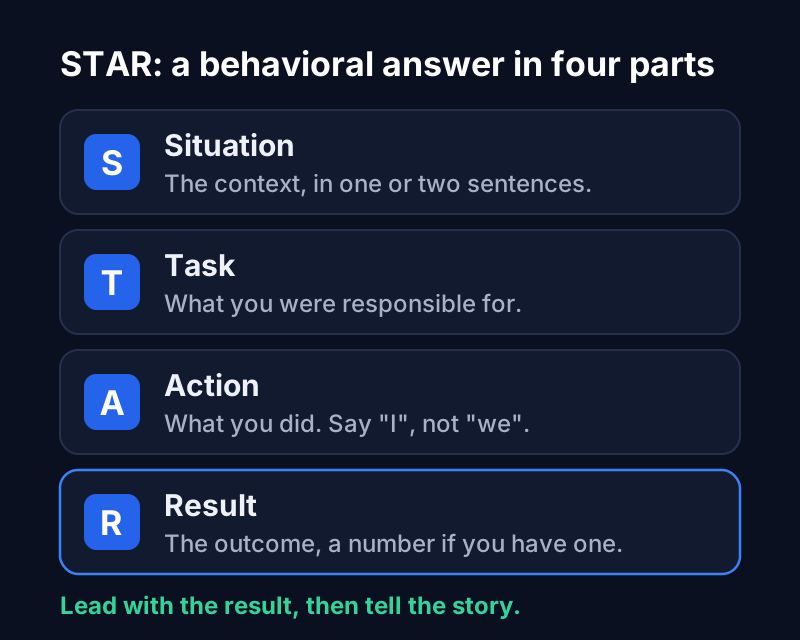
Situation: the project and what the disagreement was about, in a sentence or two. Task: what you were responsible for. Action: how you raised it, how you listened, and how the decision was made. Result: what happened to the work and to the working relationship.
Spend most of the answer on the action. That is where the interviewer learns how you behave when someone disagrees with you.
How a conflict story backfires
Each of these tells the interviewer more about you than about the conflict:
- Describing the other person as lazy, difficult or incompetent.
- A conflict about personalities rather than about the work.
- Settling it by going over someone's head as the first move.
- "I have never had a conflict", which suggests you avoid disagreement or do not notice it.
Follow-up questions to expect
A good interviewer pushes on your answer. These are examples of the kind of follow-up to prepare for; our AI interviewer writes its own from what you actually said.
- "What would you have done if your fix had not worked?"
- "How did that teammate feel about the outcome?"
- "Tell me about a time you disagreed and turned out to be wrong."
- "When would you escalate a disagreement to a manager?"
How to adjust it for your level
- Intern
- Group projects, clubs, sports teams and part-time jobs are all fair sources. Pick a disagreement about the work, such as how to split tasks or which approach to take, rather than a personal clash.
- New grad
- A project or internship disagreement is ideal. Show that you listened, that you proposed a way to decide, and what you did to keep working well with the person afterwards.
- Experienced
- Choose a disagreement with real stakes, with a peer or another team, and show how you reached a decision. Senior candidates are expected to describe how they changed a process so the same conflict did not recur.
- India campus placement
- Panels may ask a version of this about your final-year project team. Keep it about the work, describe your teammate respectfully, and finish with how the team delivered.
Answer it out loud, then read the evidence
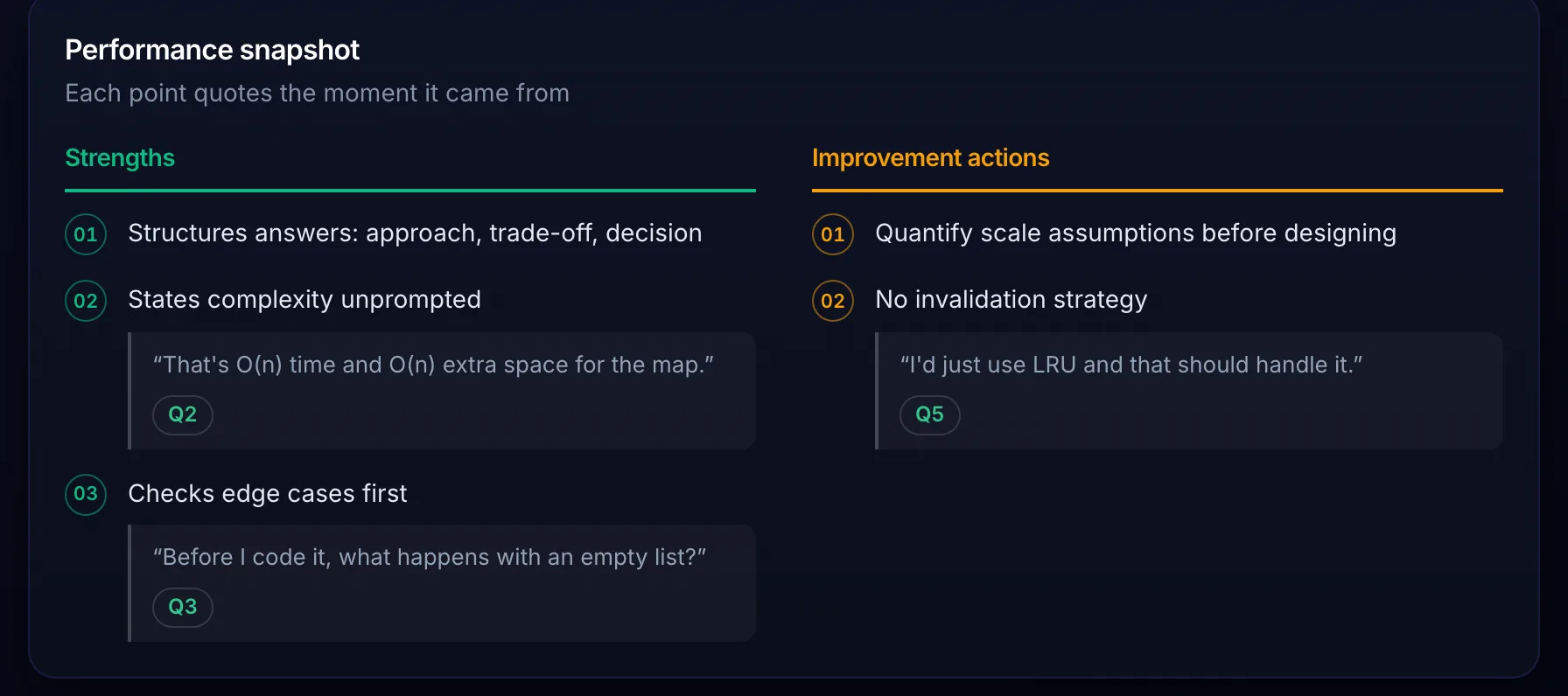
Reading a good answer is not the same as saying one. In a Practice interview the AI interviewer asks out loud, follows up on what you said, and the report quotes the sentences behind each strength and gap.
Frequently asked questions
What if I have never had a conflict with a coworker?
Use a disagreement instead: a time you and a teammate wanted different approaches. Every team has those, and they make a better answer than a personal clash.
Is it okay if I was wrong in the story?
Yes, and it can be a strong answer if you show how you realized it and what you did next. Interviewers value people who can change their mind on evidence.
Should I mention escalating to a manager or professor?
Only as a later step after you tried to resolve it directly, and say why it was needed. Escalating first suggests you cannot handle disagreement yourself.
How do I answer as a fresher?
Use a group project, internship or club story about a disagreement over the work. Describe both positions fairly and how the decision was made.
How long should the answer be?
About two minutes. Keep the setup short and spend most of the time on what you did and how the relationship held up.
Can I practice this question with an AI interviewer?
Yes. A free Practice interview asks behavioral questions out loud and follows up on how you handled the disagreement. The report quotes the sentences behind each strength and gap, and Practice never counts toward a verified score.
More common questions: Tell me about yourself, Why should we hire you?, What are your strengths and weaknesses?, Why do you want to work here?, Where do you see yourself in 5 years?, Tell me about a time you failed, Why are you leaving your current job?, What is your greatest achievement?, How do you handle pressure?. Or browse interview questions by role and interview prep.