
Interview prep
Good interview prep has three parts: know what the interviewer is checking, have your stories ready, and rehearse out loud until the answers hold up under a follow-up. Prep often stops after the first two. This page covers all three and ends with a real interview you can run today.
Free plan, no card required.
How it works
Learn the round
Read how the interview for your role is structured, round by round, and what each round is graded on. Our role guides and question pages lay it out for free.
Rehearse out loud
Run a live AI interview for that role. Answer by voice, take the follow-ups, and finish the round the way you would on the day.
Fix one thing
The report quotes the exact moment behind every gap. Pick the one that cost the most, fix it, and run the round again.
Know what the interviewer is checking
Every round has a job. A technical screen checks that you know the fundamentals and can reason out loud. A behavioral round checks for real examples, ownership and self-awareness. A hiring-manager conversation checks fit, judgment and how you talk about past work. Prepare for the wrong job and even good answers miss.
Start with the interview questions for your role and the round-by-round guide for it. Then read the rubric: we publish the dimensions every interview type is graded on, so you know what a strong answer has to show.
Build your stories with STAR
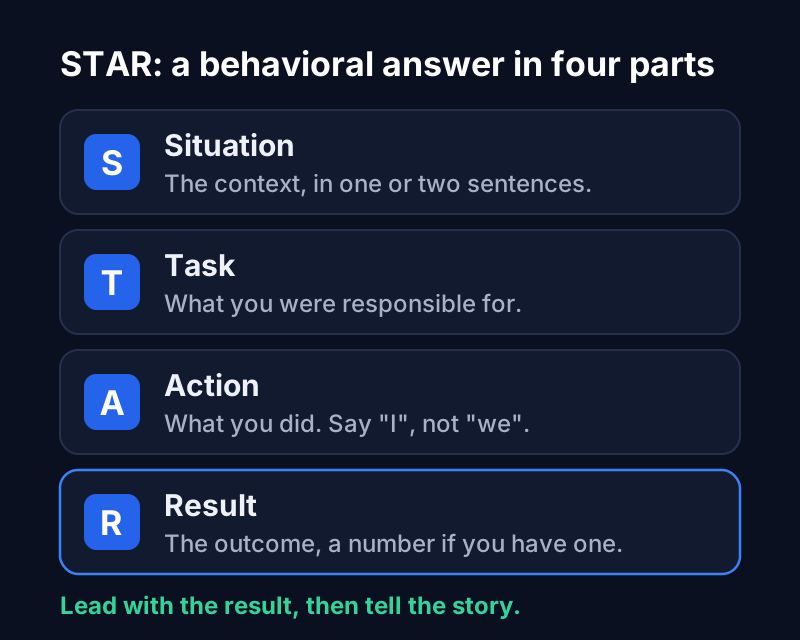
Behavioral questions ("Tell me about a time you disagreed with a teammate") are where unprepared candidates ramble. The fix is structure. STAR keeps an answer to four parts: the Situation in a sentence or two, the Task you owned, the Action you took (say "I", not "we"), and the Result, with a number if you have one.
Write five or six stories that cover the common themes: a conflict, a failure, a deadline, a time you led, a time you learned something fast. Many behavioral questions map onto one of those themes. When you tell a story, say in one line where it is going, then tell it in STAR order.
Rehearse until it holds up under follow-ups
Reading answers in your head is not rehearsal. The real test is the follow-up: "Why that approach?" "What would you do differently?" "What did your manager think?" You only find out whether your story survives that when someone asks.
A live AI interview asks those follow-ups for you. It listens to your answer and pushes on the weakest part, the way a human interviewer does, and you can run it as many times as your plan allows, at 11pm the night before if that is when you are ready.
Read the evidence, fix one thing
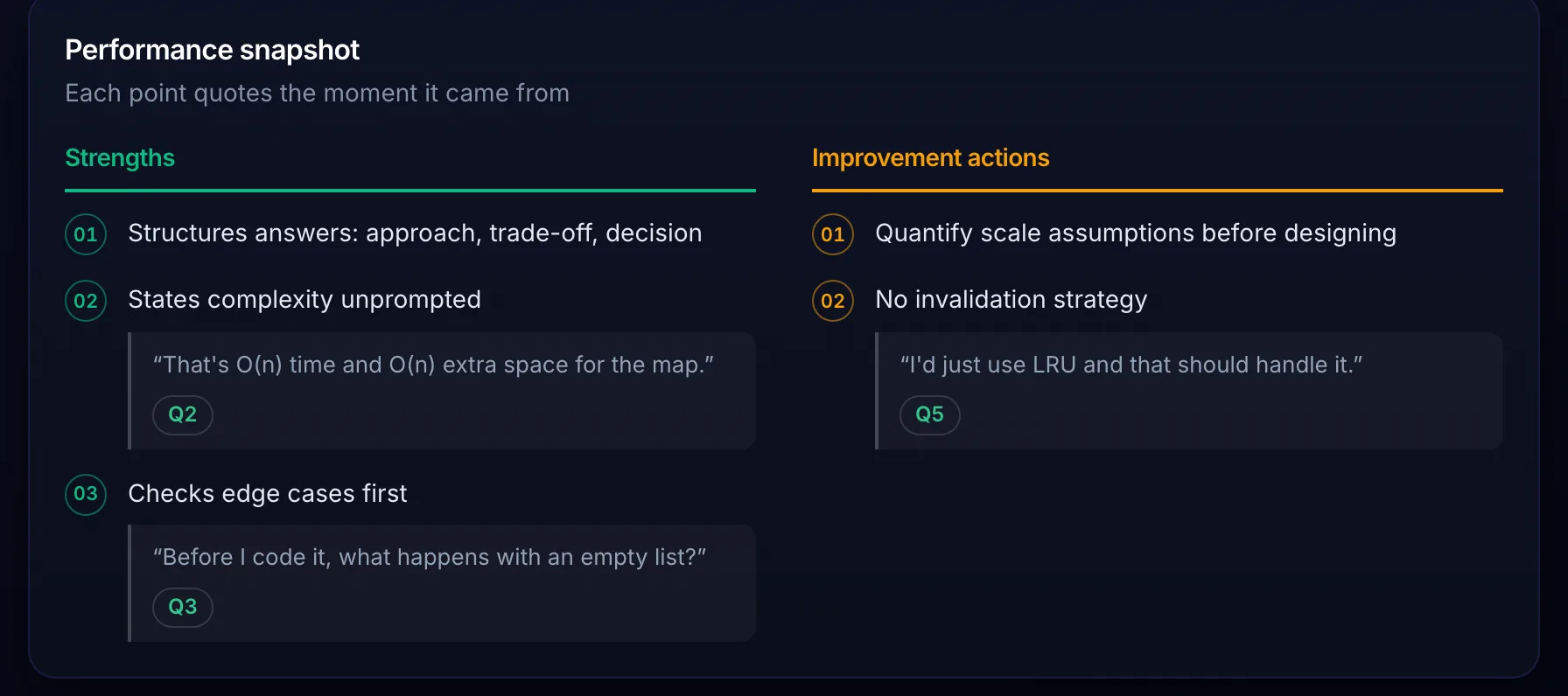
After each interview, the report shows your overall result and quotes the exact sentence behind each strength and gap. Choose the single gap that cost you most and fix only that before the next run. Small, targeted changes compound faster than rewriting everything.
Interview prep for students and new grads
If this is your first real interview season, you are not expected to have years of experience. You are expected to explain what you did on projects, internships and coursework clearly, and to show how you think. Use class projects and internships as STAR stories, practice the technical screen for your target role, and run at least one full mock interview before your first real one.
The free plan is enough to start: Practice interviews with a feedback report, no card required. When you want proof to show employers, a graded Lifelike interview puts a verified score on your Profile Card.
Frequently asked questions
How should I prepare for an interview?
Learn what each round is checking, prepare five or six STAR stories that cover the common behavioral themes, review the technical fundamentals for your role, and rehearse out loud with someone who asks follow-up questions. Then fix the single weakest answer and rehearse again.
How long does interview prep take?
It depends on the role and how recently you interviewed. Reviewing the round structure and writing your stories takes a few evenings; rehearsing until the answers hold up under follow-ups is what takes longest, so start that early.
What is the STAR method?
A structure for behavioral answers: Situation, Task, Action, Result. Give the context briefly, say what you were responsible for, describe what you did in the first person, and finish with the outcome, with a number if you have a true one.
Is there free interview prep?
Yes. The role guides, interview question pages and scoring rubric on this site are free to read, and the free plan runs Practice AI interviews with a feedback report, no card required.
How do I practice answering out loud on my own?
Use a live AI interviewer. It asks the question by voice, listens, and follows up on what you said, which is the part that solo rehearsal in your head cannot reproduce. The report then shows which sentences worked.
Do practice interviews affect my score?
No. Practice interviews never count toward your verified score and are not part of your Profile Card. Only Lifelike interviews are graded onto it.