Mock interview
A mock interview only helps if it feels like the real one: a person asking, a clock running, a follow-up you did not expect. This one runs any time you are ready, for the role you are applying to, and ends with feedback that points at the exact moment to fix.
Free plan, no card required.
How it works
Choose role and round
Pick the job and the kind of round you are facing: technical, coding, behavioral, system design or an HR conversation about fit.
Talk it through
The AI interviewer asks a question out loud, listens to your answer and follows up on what you actually said, the way a human screener does. You answer by speaking, not typing.
Read the report
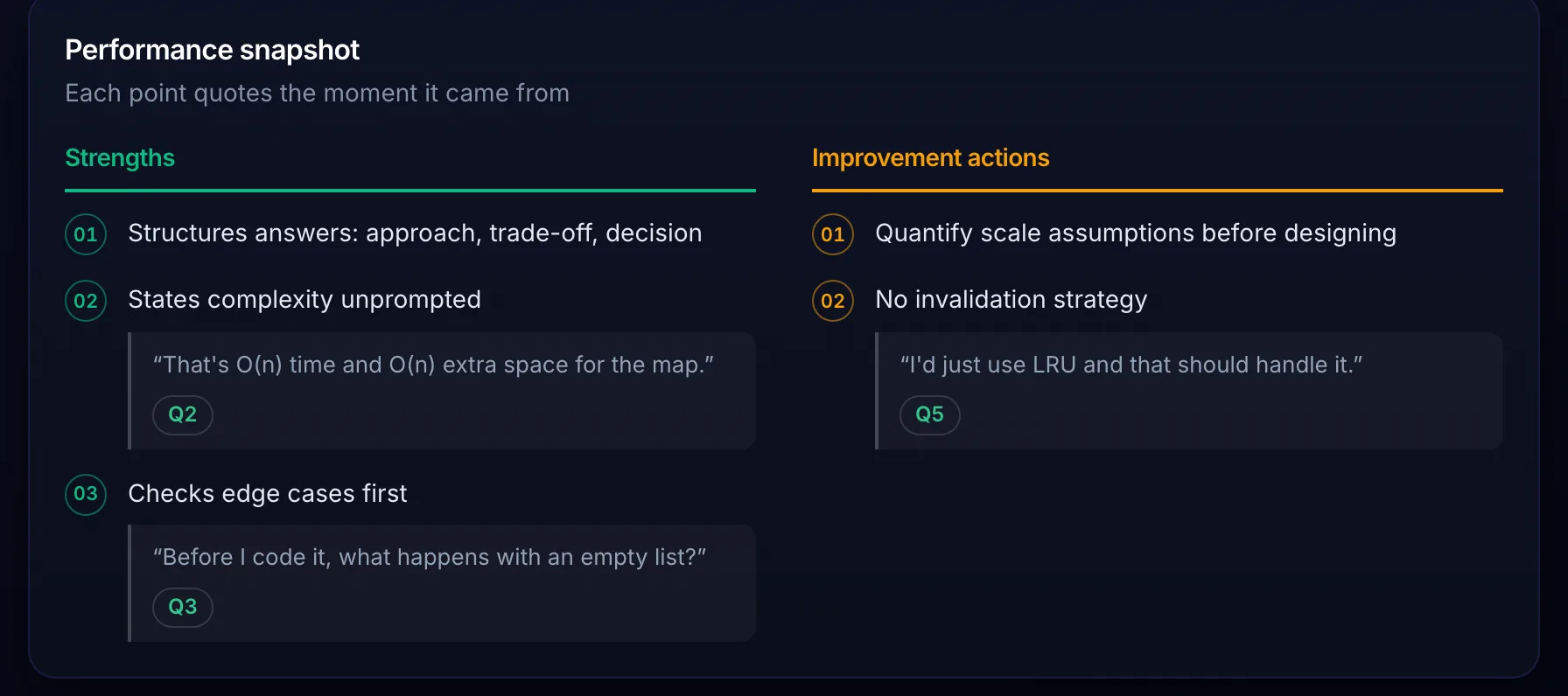
You get a report with an overall score, the strengths and gaps it found, and the exact sentence from your interview behind each one, so you know what to fix before the next round.
Why a mock interview with a friend often falls short
A friend running your mock interview usually accepts your first answer, does not know what a good answer for your role looks like, and cannot tell you which sentence lost them. Recorded-video tools fix the scheduling but drop the conversation: you talk to a static prompt and nobody pushes back.
What actually changes your results is repetition against an interviewer who listens and probes, followed by feedback specific enough to act on. That is the loop this mock interview is built around.
The rounds you can rehearse
Real hiring loops are a sequence of different interviews, each looking for something different. You can rehearse each one on its own terms, and each is graded against its own rubric:
- Technical screen: knowledge, problem solving, coding and communication.
- Hands-on coding: correctness, code quality, efficiency and your approach.
- Behavioral: collaboration, communication, self-awareness and real examples.
- System design: trade-offs, edge cases and conceptual clarity.
- HR and fit: how your experience, goals and expectations match the role.
Feedback you can use before the next round
The report does not stop at a number. Every strength and gap quotes the sentence it came from and the question it was in, so you can reread the exact answer, see what was missing and say it better next time. The full transcript stays attached.
Run the same round again a few days later and compare. Improvement you can see in your own words is the fastest kind. If the same gap shows up twice, that is the one to work on before the real interview: write the better answer down, say it out loud a few times, then run the round again and check whether the report still flags it.
From mock interview to verified score
Practice interviews are rehearsal: they never count toward your score and are not part of your Profile Card. When you are ready, a Lifelike interview is graded against the published rubric and becomes part of your Profile Card, a credential you can share by link or, on the plans that include it, make visible to recruiters. Your card is private until you decide otherwise.
That is the difference between a mock interview that ends when you close the tab and one that can work for you after it.
How to get the most from a mock interview
A few habits make every session count more:
- Treat it as real. Sit where you would for the real call, close other tabs, answer out loud in full sentences.
- Pick one fix per session. Read the report, choose the single gap that cost the most, and work on only that next time.
- Rehearse the round you fear most, not the one you are best at.
- Read your own transcript. You will hear filler and detours you never notice while speaking.
Frequently asked questions
Can I do a mock interview online for free?
Yes. The free plan runs Practice mock interviews with a feedback report and needs no card. Paid plans add graded Lifelike interviews, which put a verified score on your Profile Card.
Do I need to schedule a time?
No. The interviewer is an AI, so you start whenever you are ready. There is nothing to book and nobody waiting on you.
What kinds of interview can I practice?
Technical, coding, behavioral, system design and HR rounds, for a wide range of roles in and outside tech. Each kind of round is graded against its own rubric.
Is a mock interview the same as the real interview?
It follows the same shape: role-specific questions, live follow-ups and a structured evaluation. It is not the employer's own interview, and a practice score never stands in for one. A Lifelike interview produces a verified score you can share.
What is the difference between a mock interview and an AI mock interview?
A mock interview is any rehearsal of a real interview, with a friend, a coach or a tool. An AI mock interview replaces the person asking with an AI interviewer that speaks, listens and follows up, so you can run one whenever you are ready and get a structured report after each interview.
Who can see my results?
Only you, by default. Practice reports stay private unless you share one yourself. Lifelike results go on a Profile Card that stays private until you share it by link or opt in to recruiter visibility.