
What do business analyst interviews ask?
A business analyst interview tests whether you can find out what a business actually needs and write it down so that other people can build it. Expect questions on gathering and prioritizing requirements, mapping a process, working with stakeholders who disagree, and a case where you structure an unclear problem. The technical content is lighter than for a data analyst, with some SQL or spreadsheet work, but the weight on structured thinking and clear writing is heavier.
Business Analyst interview questions, by round
19 questions across 5 rounds.
Recruiter and background screen
Establishes what part of a project you have actually owned and which methods and tools you have used in practice.
- What is the difference between a business requirement and a functional requirement, with an example from a project of yours?
- Tell me about the most complex project you supported. What was your role, specifically?
- Which documents did you produce, and who actually used them?
- How do you decide which tools to use to capture requirements?
Requirements and stakeholders
Looks at how you elicit what people need, reconcile conflicts and keep scope under control.
- Two stakeholders give you contradictory requirements. How do you resolve it?
- How do you prioritize a long list of requests when everything is called urgent?
- A stakeholder asks for a solution, such as a new report. How do you find the underlying need?
- What do you do when requirements change halfway through development?
- How do you know a requirement is testable?
Process analysis and documentation
Checks that you can map how work happens today, find where it breaks and describe a better version.
- Walk me through how you would map an as-is process for approving expense claims.
- How would you decide whether a process problem is a people, process or system problem?
- Write the acceptance criteria for a feature that lets customers cancel an order.
- What goes in a user story, and when is it too big?
Case and analytical problem
A business problem with limited information. The interviewer is looking for structure, sensible assumptions and a recommendation.
- Customer complaints about delivery times have gone up. How do you approach it?
- A company wants to add a new payment option. How do you assess whether it is worth it?
- How would you estimate the cost of a manual process that several teams do by hand?
Behavioral
Tests influence without authority, since a business analyst usually has none.
- Tell me about a time you changed a stakeholder mind using evidence.
- Describe a project that did not deliver what the business expected. What was your part?
- How do you handle a developer who says a requirement is unclear?
Sample answers
Illustrative answers written for this guide, not transcripts of real candidates.
A stakeholder asks for a solution, such as a new report. How do you find the underlying need?
I treat the request as the start of a conversation, not a specification. I would ask what decision the report would help them make, who else uses it, what they do today to get that information and what goes wrong. For example, if a sales manager asks for a weekly report of lost deals, the real need might be to find out why deals are lost, which a report of names does not answer. I would then check whether something that already exists covers it before building anything new, restate the need back to them in one sentence, and agree how we will know it worked. Only then would I write a requirement, and it would describe the outcome, such as the manager can see lost deals by reason each week, and leave the layout to the design stage.
Why it scores: Problem-Solving: moves from a stated solution to the underlying decision. Communication: restates the need and agrees a measure of success. Technical: writes the requirement as an outcome that can be tested rather than a layout.
Two stakeholders give you contradictory requirements. How do you resolve it?
First I check that the conflict is real. Often the two people are describing different cases, or one is a preference and the other is a rule. If it is real, I get both in a conversation, not through me as a messenger, and ask each what goal sits behind their request. Finance wanting approval above a threshold and operations wanting no delays might both be satisfied by approval only above a higher amount, with a monthly review below it. If they still disagree, I lay out the options with the cost and risk of each and take it to whoever owns the decision, with my recommendation. I record the decision, who made it and why, so it does not reopen at test time. I would not choose a side quietly, and I would not leave it for the developers to guess.
Why it scores: Behavioral: influences without authority and escalates in a sensible way. Communication: brings the parties together and records the decision. Problem-Solving: looks for the goals behind positions to find a third option.
Customer complaints about delivery times have gone up. How do you approach it?
I would start by defining the problem: late against what promise, and is it complaints per order that rose, or just volume? Then I would break the delivery journey into stages, from order placed to picked, packed, handed to the carrier and delivered, and look at where time is added compared to before. I would segment by region, carrier, product type and warehouse to see whether the problem is everywhere or in one place. I would also talk to the support team, since the complaint text often says what the numbers cannot. If it is one carrier in one region, the options are different from a warehouse backlog. I would end with the likely cause, how sure I am, a recommended action and what we would measure to know it worked.
Why it scores: Problem-Solving: a structured breakdown of the process that separates causes. Technical: segments data to localize the problem. Communication: closes with a recommendation and a measure of success, not just analysis.
Describe a project that did not deliver what the business expected. What was your part?
On an internal approvals tool I helped with, we delivered on time, but the approvers barely used it. When I looked back, I had written requirements from conversations with the managers who requested it, and I never watched an approver do the job. They approved from their phones between meetings, and the screens assumed a desktop. My part was that I did not test the requirements with the people who would use the tool. We ran short sessions with approvers, rewrote the key stories around mobile use and shipped a second version that they did adopt. Now I always list the people who will use something, not just those who asked for it, and I watch at least one of them do the task before I write the requirement.
Why it scores: Behavioral: owns a specific mistake and the change that followed. Problem-Solving: traces the failure to a gap in elicitation. Communication: the answer is structured as situation, own part, fix and lesson.
What a Business Analyst answer is scored on
- Problem-Solving
- Structuring an unclear business problem, getting from a stated request to the underlying need, and choosing a sensible next step with limited information.
- Code Quality
- For this role, the quality of what you produce: requirements that are clear, testable and unambiguous, acceptance criteria that cover failure cases, and queries or spreadsheets that are tidy and checkable.
- Technical
- Working knowledge of process mapping, requirements methods, basic SQL or spreadsheet analysis and how software is delivered, enough to talk to developers precisely.
- Communication
- Elicitation, writing and facilitation: asking good questions, restating what you heard and getting competing groups to a decision.
- Behavioral
- Influence without authority, handling changing scope and owning projects that did not go well, with specific examples.
These are the five dimensions every interview rolls up to. The full rubric and its measured limits are on the scoring page.
How a Lifelike Business Analyst interview is scored
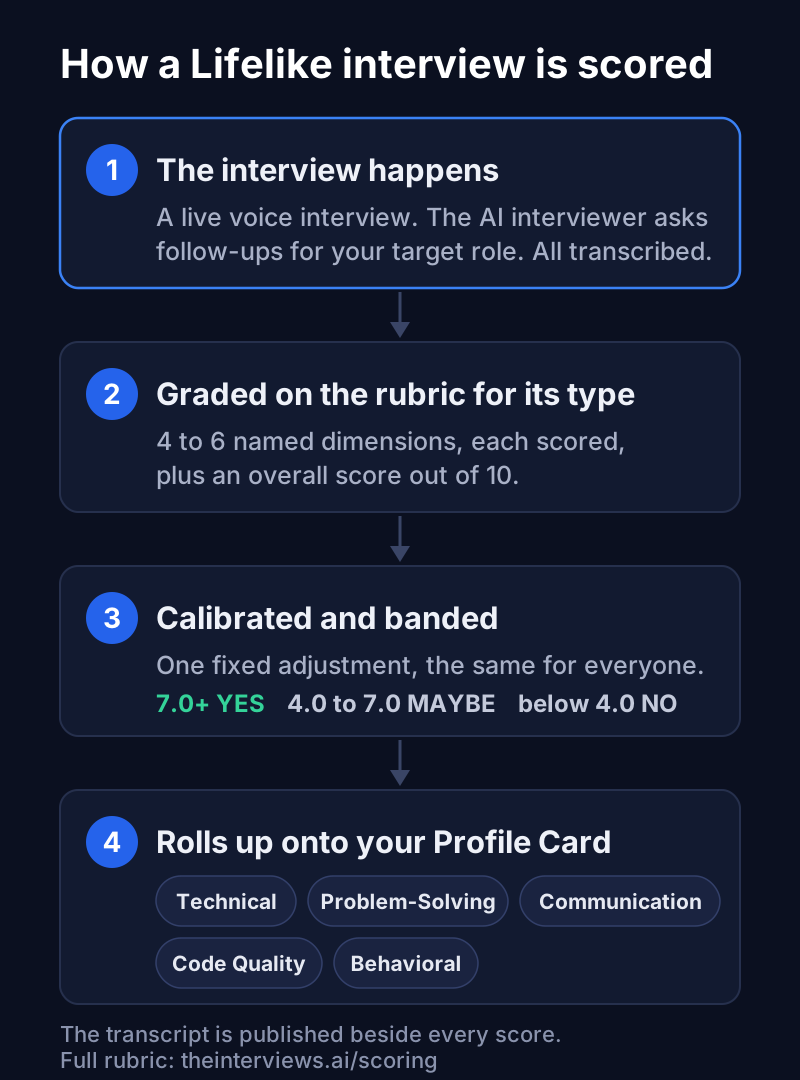
What the report shows you
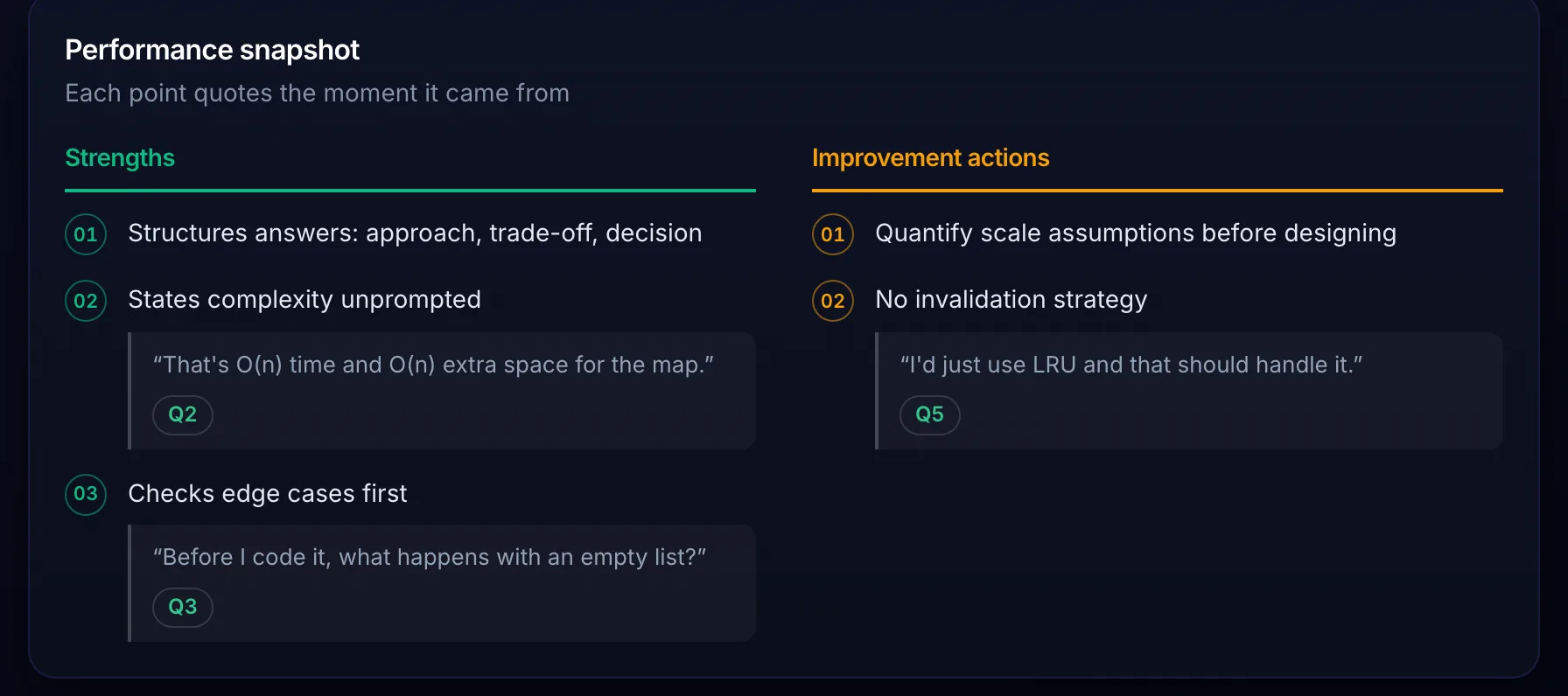
How to prepare
- Pick two projects and be able to state your own part, the requirement you wrote, and what happened to it after release.
- Practise writing a user story with acceptance criteria that include a failure case, such as what happens when payment fails.
- Learn to draw a simple as-is process with owners and hand-offs, and mark where delays and rework happen.
- Rehearse a case structure: define the problem, break it into stages or drivers, find where the issue concentrates, recommend, say how to measure.
- Prepare a story about a stakeholder conflict where the outcome was a decision, and say how you recorded it.
Business Analyst interviews: common questions
Do business analyst interviews include technical questions?
Usually some. Expect basic SQL or spreadsheet questions, and questions on how software is built and tested, such as user stories and acceptance criteria. The depth varies a lot by employer, and technical business analyst roles ask for more.
What is the difference between a business analyst and a data analyst?
A business analyst focuses on what the business needs and how a process or system should change. A data analyst focuses on answering questions from data. The roles overlap, and many postings ask for both, so read the posting for how much SQL and how much requirements work it describes.
Which certifications matter?
They can help for some employers, but interviewers mostly test how you work. Be ready to describe a real project in detail whether or not you hold a certificate.
How do I practise?
Run a mock interview for the Business Analyst role and answer out loud. The feedback report scores each answer on the five dimensions above and shows the transcript next to the score.