
What do software engineer intern interviews ask?
A software engineer intern interview is usually a short behavioral screen, one or two coding rounds on data structures and algorithms, and a conversation about a project you built. Interviewers do not expect production experience. They want to see you turn a vague problem into a working solution, say what you are doing while you do it, test your own code, and explain a project you actually wrote in enough detail that it is clearly yours.
Software Engineer Intern interview questions, by round
18 questions across 4 rounds.
Recruiter or behavioral screen
Checks that you can talk about your own work clearly and that you want this internship for a reason you can name.
- Walk me through your resume, focusing on the project you are most proud of.
- Why do you want a software engineering internship, and why this team?
- Tell me about a time a group project went wrong. What did you do?
- Describe a bug that took you much longer to fix than you expected.
- What is something technical you taught yourself outside of class?
Coding round
One or two problems in a shared editor, usually arrays, strings, hash maps, two pointers, trees or graphs. Correctness matters, but so does how you get there.
- Given an array of integers and a target, return the indices of two numbers that add up to the target.
- Check whether a string of brackets is balanced.
- Merge two sorted linked lists into one sorted list.
- Find the length of the longest substring without repeating characters.
- Return the level-order traversal of a binary tree.
- Count the number of islands in a grid of land and water cells.
CS fundamentals
Short conceptual questions, often woven into the coding round, to see whether you understand the tools you just used.
- What is the time complexity of your solution, and could you do better?
- When would you choose a hash map over a sorted array?
- What is the difference between a process and a thread?
- What happens, step by step, when you type a URL into a browser?
Project deep dive
The interviewer picks one project from your resume and keeps asking why until they reach the edge of what you know.
- Draw the architecture of this project. Where does the data live?
- What was the hardest technical decision in it, and what did you trade away?
- If ten times as many people used it tomorrow, what would break first?
Sample answers
Illustrative answers written for this guide, not transcripts of real candidates.
Given an array of integers and a target, return the indices of two numbers that add up to the target.
Before I code, can I check two things: can the same element be used twice, and is there always exactly one answer? Assuming no and yes. The brute force is to check every pair, which is O(n squared). Better: walk the array once and keep a hash map from value to index. For each number I compute target minus the number; if that complement is already in the map I return both indices, otherwise I store the current number. That is O(n) time and O(n) space. I will test it on [2, 7, 11, 15] with target 9, then on a case with a negative number and a case where the pair is a duplicate value, like [3, 3] with target 6, because storing after the check is what makes that one work.
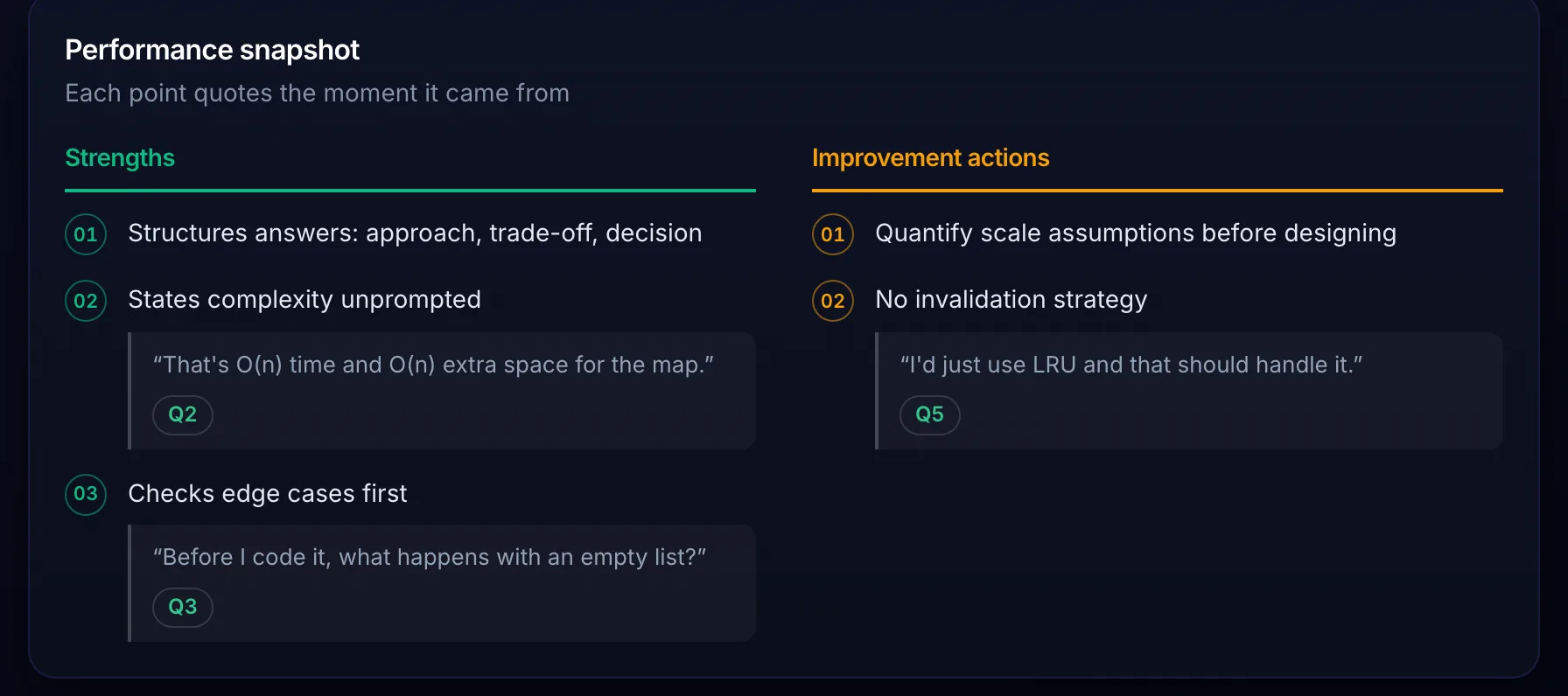
Why it scores: Problem-Solving: clarifies the constraints before coding and names the brute force before improving it. Communication: states the complexity unprompted. Code Quality: picks test cases that hit the edge the happy path misses.
Describe a bug that took you much longer to fix than you expected.
In my class scheduling app, about one request in twenty returned another student’s timetable. I assumed it was the database query and spent a day there. It was not reproducible locally, so I added a request ID to every log line and found two requests sharing state. I had stored the logged-in user in a module-level variable in the server, so concurrent requests overwrote each other. I moved it into the request context and wrote a test that fires two requests at once. What I changed after: I reproduce with logs before I touch code, and I treat any global mutable state in a server as a bug until proven otherwise.
Why it scores: Behavioral: a real, specific situation with your own actions in it. Problem-Solving: shows the wrong first guess and how evidence replaced it. Technical: the root cause is named precisely, not "a race condition somewhere".
If ten times as many people used it tomorrow, what would break first?
The first thing would be the search endpoint. It runs a LIKE query over the whole courses table on every keystroke, and there is no index that helps a leading wildcard. I would debounce the input on the client so we send one request per pause instead of per key, then move search to a prefix index or a small full-text index. Second would be the single server process; it is stateless now, so I could run more than one behind a load balancer. I would measure before doing either: I would log query time first so I know which one is actually the bottleneck.
Why it scores: Technical: identifies a concrete bottleneck in code you wrote, not a generic "add caching". Problem-Solving: orders the fixes by impact and says what to measure first. Communication: the answer has a clear structure.
Why do you want a software engineering internship, and why this team?
I have built three projects on my own, and every one stopped at the point where I would need code review, real users and someone to tell me what good looks like. An internship is the fastest way to get that. This team specifically: you own the scheduling service, and the hardest part of my own project was scheduling with conflicting constraints, so I would arrive already caring about the problem. I would like to come out of the summer having shipped something that real users depend on, with tests and a reviewer who pushed back on it.
Why it scores: Behavioral: a specific reason tied to your own history, not flattery. Communication: says what you want to learn and what you will bring. Avoids the generic "I am passionate about technology" answer interviewers hear all day.
What a Software Engineer Intern answer is scored on
- Problem-Solving
- Do you clarify the problem, start from a working idea and improve it, and recover when the first approach fails? For interns this weighs more than knowing the optimal trick.
- Code Quality
- Readable names, small functions, and tests you choose yourself, including the empty, single-element and duplicate cases.
- Technical
- Correct complexity analysis and the fundamentals behind the data structure you picked. Depth on your own project counts here too.
- Communication
- Thinking out loud so the interviewer can follow, and structuring answers instead of narrating everything.
- Behavioral
- Specific past situations with your own actions in them, and what you changed afterwards.
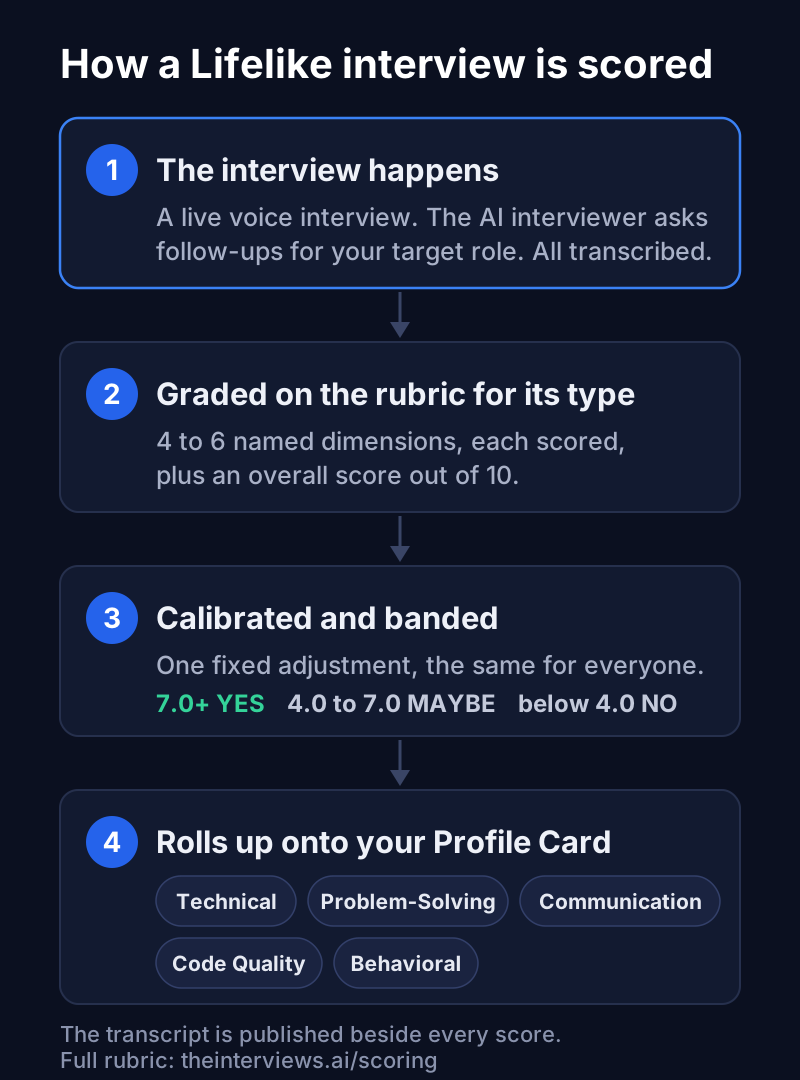
These are the five dimensions every interview rolls up to. The full rubric and its measured limits are on the scoring page.
How a Lifelike Software Engineer Intern interview is scored
What the report shows you
How to prepare
- Practise coding out loud. Silence while you type is the most common reason a correct solution still scores low.
- Learn the core patterns, not lists of problems: hash maps, two pointers, sliding window, BFS and DFS, sorting plus binary search.
- For every project on your resume, be ready to draw it, name one decision you would change, and say what breaks at ten times the load.
- Prepare four stories (a conflict, a failure, something you learned alone, something you are proud of) and reuse them across behavioral questions.
- Always finish a coding answer by testing it on an edge case you picked yourself.
Software Engineer Intern interviews: common questions
Do software engineer intern interviews include system design?
Rarely as a full round. Interns are more often asked lighter design questions inside the project deep dive, such as where the data lives or what breaks at more load. A full distributed-systems design round is more typical for new-grad and experienced roles.
Which programming language should I use in the coding round?
The one you are fastest and most accurate in. Python is common because it is short to write, but a correct, well-tested Java or C++ solution scores the same. Switching languages to impress is a common mistake.
What if I cannot solve the coding problem?
Say the brute-force approach, code it, and explain where it is slow. A working simple solution with a clear explanation of how you would improve it often scores better than an unfinished optimal one.
How do I practise this interview?
Run a mock interview for the Software Engineer role and answer out loud, as you would in the real one. The feedback report scores each answer on the same five dimensions described above and shows the transcript beside the score.